
Capacity
Manufacturer, liters · Higher is better
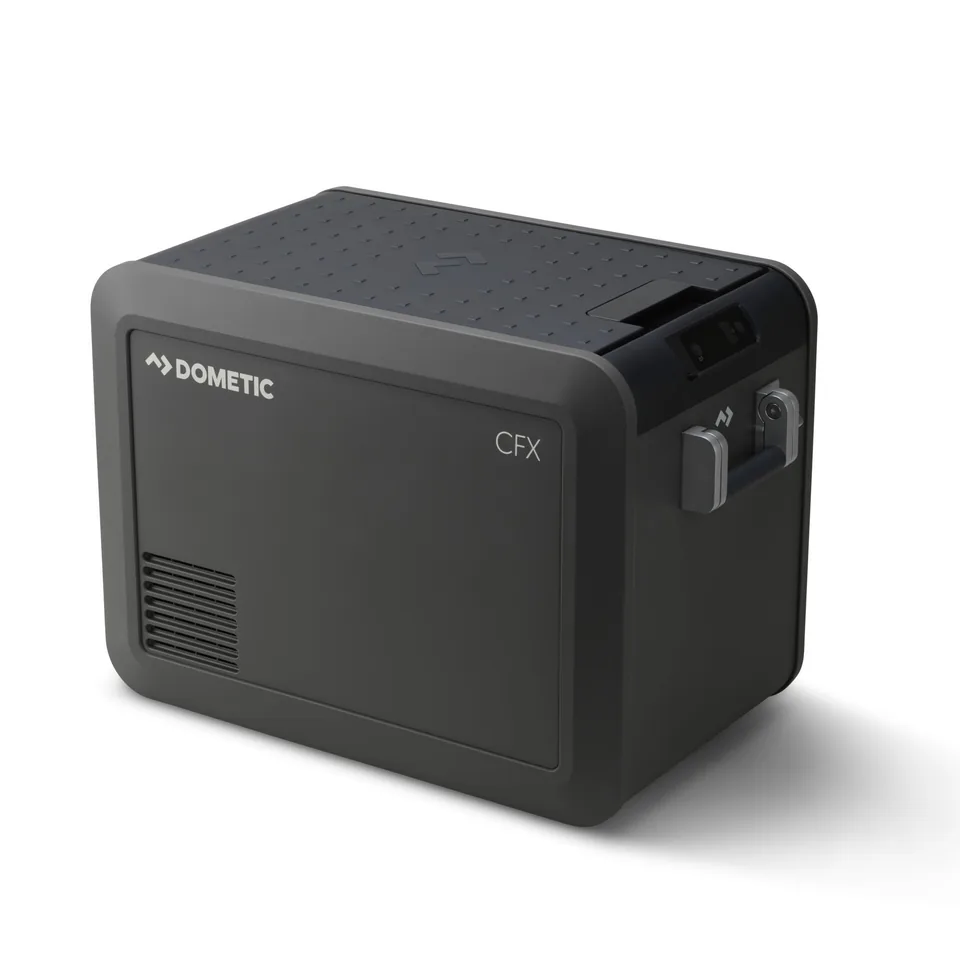
- Dometic CFX5 45 Electric Cooler46 L
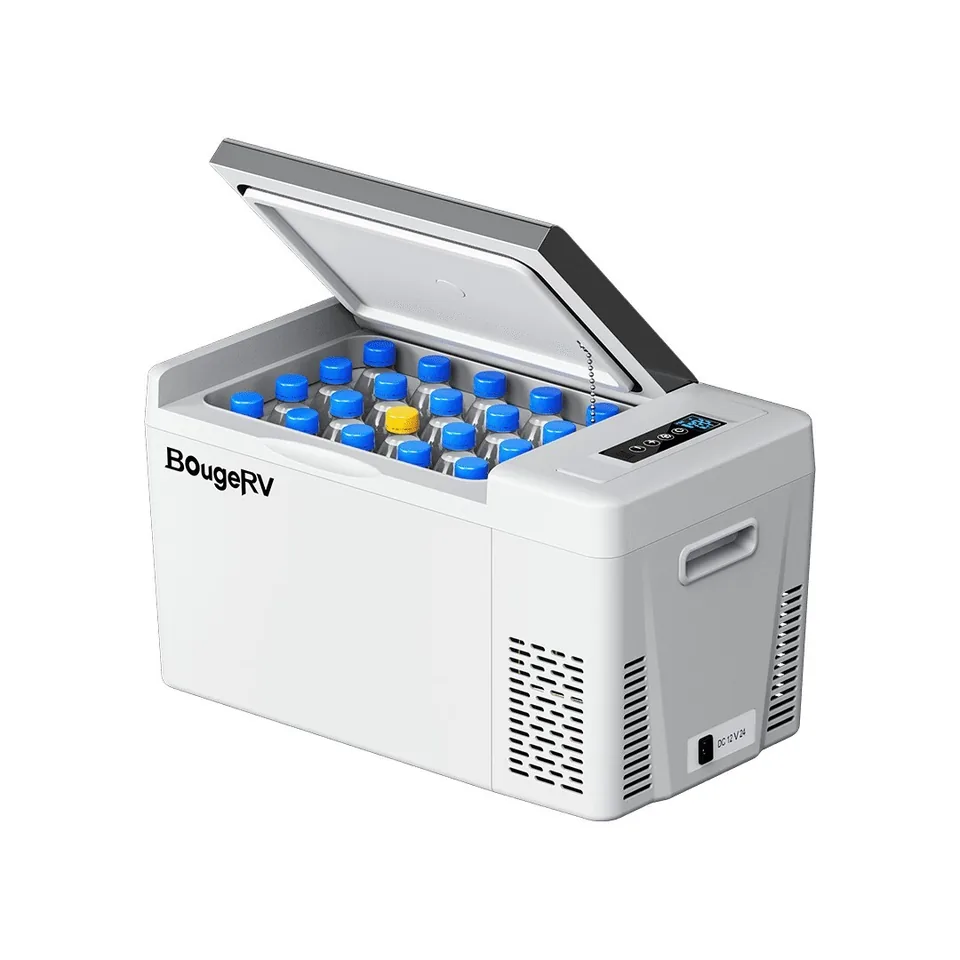
- BougeRV 23 Quart 12V Portable Refrigerator22 L
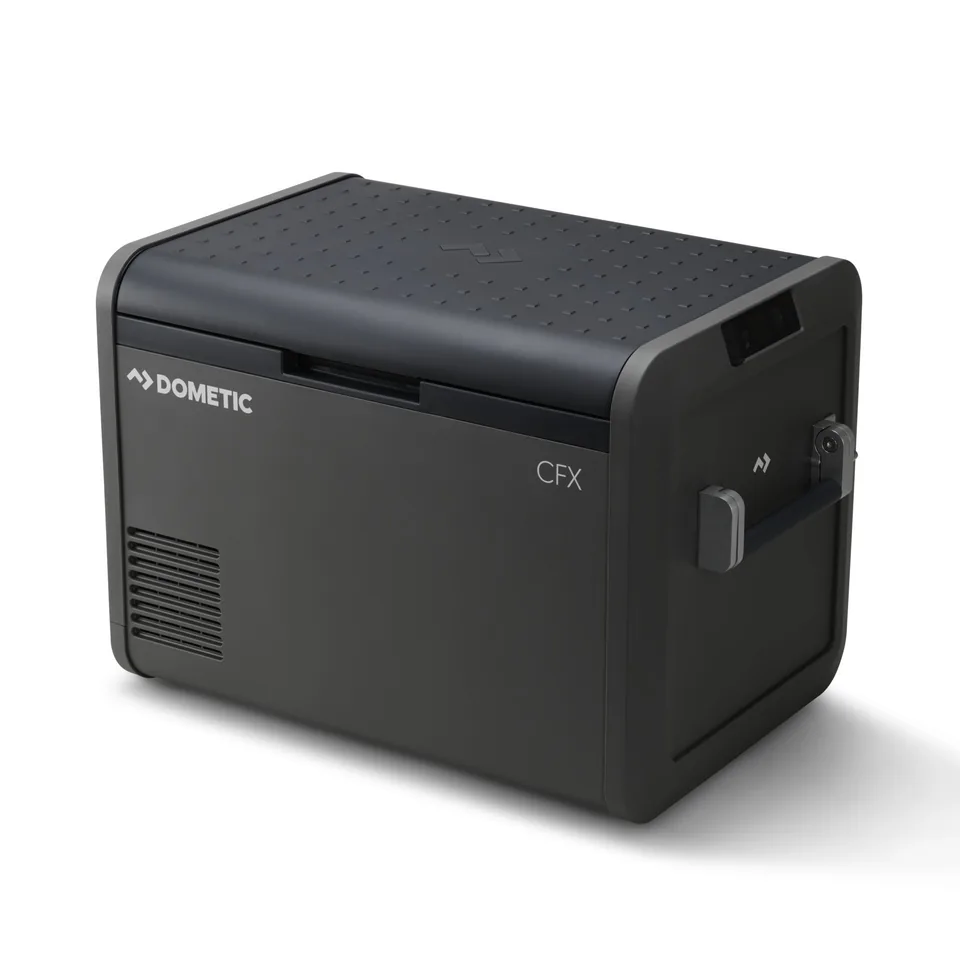
- Dometic CFX5 55IM Electric Cooler with Ice Maker55 L
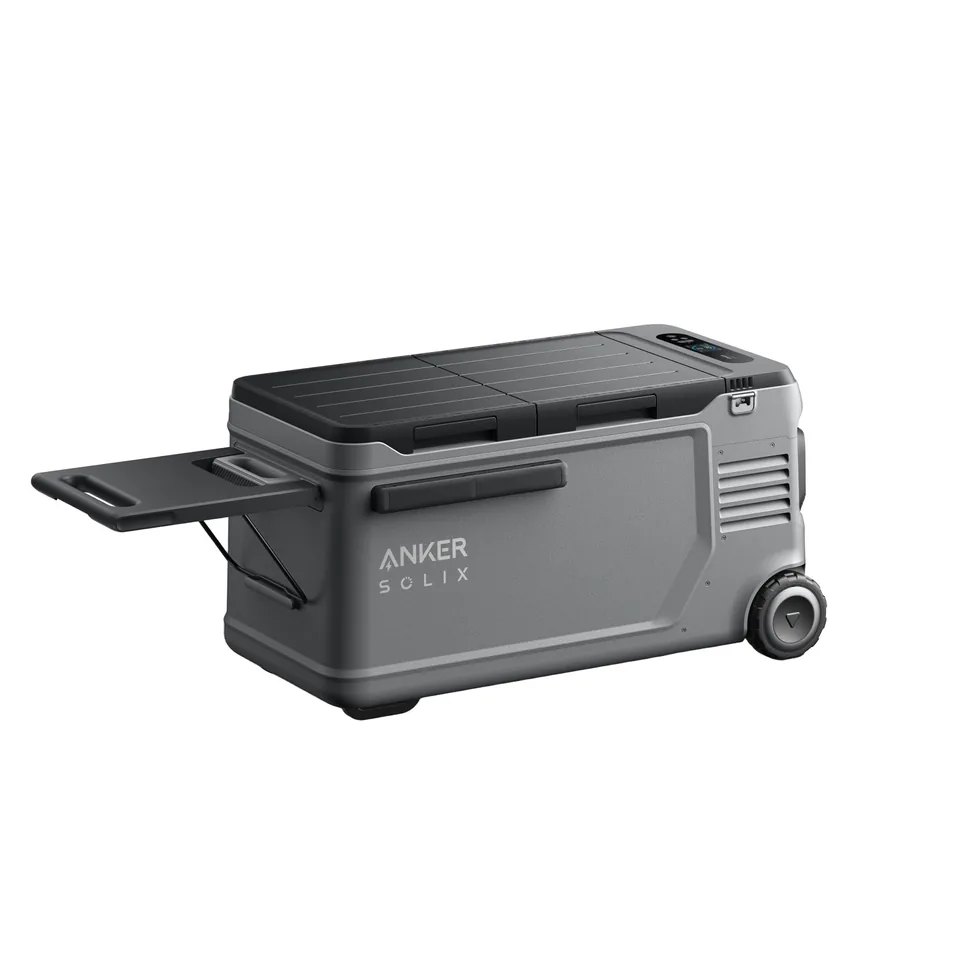
- Anker SOLIX EverFrost 2 58L Electric Cooler58 L
We compared 12V compressor fridge/freezers for car camping on measured power draw, capacity, dual-zone flexibility, battery protection, app control and weight, and worked out what each one asks of a battery or power station.
Ad disclosure: we earn a commission on Amazon links, at no cost to you. It never decides our picks. How this works
Best overall
Suits Couples and small families on long weekends
Best budget
Suits Solo or couple weekend trips, carried one-handed
Best premium
Suits Families on week-long trips who want ice
Best dual-zone
Suits Freezer plus fridge, run away from the car
From spec sheets and independent tests. The best result in a row is tagged.
| Feature | Dometic CFX5 45Best overall | BougeRV CR22Best budget | Dometic CFX5 55IMBest premium | Anker SOLIX EverFrost 2Best dual-zone |
|---|---|---|---|---|
| Capacitymanufacturer | 46 L (67 cans) | 22 L (23 qt) | 55 L (84 cans) | 58 L (61 qt), two halves |
| Dual-zone | No: Single zone | No: Single zone | Partly: Single zone + ice maker | Yes: Two zones, set separately |
| Temperature rangemanufacturer | -7°F to 68°F | -7°F to 50°F | -7°F to 68°F | -4°F to 68°F per zone |
| Power drawOutdoorGearLab measured / Dometic rated | 6.8 W steady (OutdoorGearLab) Best | 8.3 W steady (OutdoorGearLab) | 1.55 Ah/hr at 90°F (Dometic) | Not measured by our sources |
| Built-in battery | No: No, needs 12 V or AC | No: No, needs 12 V or AC | No: No, needs 12 V or AC | Yes: 288 Wh LFP, slot for a second |
| App control | Yes: Bluetooth, lid-open alerts | No: No app | Yes: Bluetooth, energy tracking | Yes: App, Eco/Smart/Max modes |
| Power sources | 12/24 V DC, 100-240 V AC | 12/24 V DC, 110-240 V AC | 12/24 V DC, 100-240 V AC | AC, car, 100 W solar, USB-C |
| Empty weightmanufacturer | 40.3 lb | 21.2 lb Best | 44.4 lb | 63.7 lb, 6-in wheels |
| On Amazon | Check price on Amazon(paid link) for Dometic CFX5 45 Electric Cooler (opens in a new tab) | Check price on Amazon(paid link) for BougeRV 23 Quart 12V Portable Refrigerator (CR22) (opens in a new tab) | Check price on Amazon(paid link) for Dometic CFX5 55IM Electric Cooler with Ice Maker (opens in a new tab) | Check price on Amazon(paid link) for Anker SOLIX EverFrost 2 58L Electric Cooler (opens in a new tab) |
Who each one is for, and what to know before you buy.
01Best overall
The 12V fridge to buy if you want one box that holds temperature precisely, sips power and lasts for years in a truck bed. It costs more than most rivals, and the efficiency is where that money goes.
Pick it ifCouples and small families who car camp for long weekends and want a fridge that a 300 to 1,000 Wh power station can run for days
Skip it ifAnyone who needs a separate freezer compartment, or who camps a few nights a year and is happy with a cooler and ice
Why it made the list. OutdoorGearLab's top-rated electric cooler, measured at 6.8 W once cold and within 0.3°F of its set point. Vacuum-insulated walls, 3-stage battery protection and a Bluetooth app. The latch needs a firm press to seal.
02Best budget
The cheapest sensible way into real compressor refrigeration for one or two people. It is small, light and cold enough to freeze, and it asks you to accept no app, some condensation and a fussy DC plug.
Pick it ifSolo campers and couples on weekend trips who want food kept cold without ice and need a fridge they can carry one-handed
Skip it ifFamilies, week-long trips, or anyone who wants to check the temperature from a phone
Why it made the list. A 23-quart compressor fridge that weighs about 21 lb and still reached -3.2°F in OutdoorGearLab's test. There is no app, the DC plug needs checking and it cools down slowly, but it is the cheapest sensible way into real refrigeration for one or two people.
03Best premium
The premium 12V fridge for families and long trips: more room, the same efficient insulation and fresh ice without a bag from the gas station. Budget a bigger battery, because the extra space and the ice maker cost power.
Pick it ifFamilies and groups on week-long car camping or overland trips, and anyone who wants ice for drinks without carrying a second cooler
Skip it ifSolo campers, small vehicles, or anyone running it from a power station under 500 Wh
Why it made the list. The CFX5's insulation and compressor in a 55-liter box with a built-in ice maker, and GearJunkie's top electric cooler of 2026 after a trip along the Baja coast. Dometic rates it at 1.55 Ah per hour in the heat, so pair it with a 1 kWh station.
04Best dual-zone
The dual-zone fridge for campers who do not own a power station: two independent compartments and a battery in one wheeled box. It is heavy, and real-world runtime on one battery falls well short of Anker's claim.
Pick it ifFamilies and groups who want a freezer and a fridge at once, and campers who want to run a fridge away from the car without buying a separate power station
Skip it ifSmall cars, anyone who has to lift it up stairs or into a tall truck bed, and campers who already own a 1 kWh power station
Why it made the list. Two equal zones set independently from -4°F to 68°F, plus a removable 288 Wh LFP battery, 6-inch wheels and 100 W solar input. It weighs 63.7 lb, and 9to5Toys got about half of Anker's claimed runtime with one zone freezing.
The cheap "12V coolers" sold next to these fridges are mostly thermoelectric. They move heat with a solid-state plate and can only get so far below the outside air. OutdoorGearLab and GearJunkie both put the limit at about 40°F below ambient. On a 95°F afternoon that leaves food in the danger zone. They also tend to run constantly, so they use more energy over a day than a compressor fridge that cycles off. In OutdoorGearLab's rankings, the three thermoelectric models finished last, and it marked the Igloo Iceless Versatemp "Not Recommended."
A compressor fridge works like a home refrigerator. It holds any set point in its range, freezes if you ask it to, and then idles. Every pick here is a compressor unit, including the budget one.
GearJunkie's rule of thumb is 25 to 35 liters for solo trips and weekends, 40 to 50 liters for couples and small families, and 60 to 75 liters for long trips. Our picks map onto that: the BougeRV CR22 at 22 liters, the Dometic CFX5 45 at 46, the CFX5 55IM at 55 and the Anker SOLIX EverFrost 2 58L at 58 split into two halves.
Two checks matter more than the liter figure. First, interior height: the CR22 is 9.8 in deep inside, so tall bottles lie down. Second, measure the cargo space and check that the lid can open fully where the fridge will sit.
A compressor fridge draws 40 to 60 W while the compressor runs and almost nothing when it rests. The number that matters is the average over a day. OutdoorGearLab measured steady-state draw at room temperature. Dometic publishes amp-hours per hour at 90°F, which is closer to a summer campsite. Multiply the average watts by 24 for watt-hours a day, and divide by 12 for amp-hours at 12 V.
| Pick and condition | Daily energy | Amp-hours per day | EcoFlow RIVER 3 Plus (243 usable Wh) | 1 kWh station (870 usable Wh) |
|---|---|---|---|---|
| CFX5 45, room temperature (6.8 W, OutdoorGearLab) | about 165 Wh | about 14 Ah | about 1.5 days | about 5 days |
| CFX5 45, 90°F (1.05 Ah per hour, Dometic) | about 300 Wh | about 25 Ah | about 19 hours | about 3 days |
| BougeRV CR22, room temperature (8.3 W, OutdoorGearLab) | about 200 Wh | about 17 Ah | about 1.2 days | about 4 days |
| CFX5 55IM, 90°F, ice maker idling (1.55 Ah per hour, Dometic) | about 450 Wh | about 37 Ah | about 13 hours | about 2 days |
| EverFrost 2 58L, on its own 288 Wh battery | Anker claims 39 hours; 9to5Toys' use pointed to about 20 |
The usable figures come from our guide to how many watt-hours you need. That guide plans on a conservative 600 Wh a day for a generic 12 V cooler; the efficient picks here come in well under that. Run the fridge from the station's 12 V car socket rather than an AC outlet, because the DC path skips the inverter's losses and adds a few hours to every figure above. Pre-chill the fridge and its contents on wall power before you leave; the first pull-down is the hungriest hour of the trip. If you do not own a station yet, our list of the best portable power stations covers the RIVER 3 Plus for weekends and the 1 kWh class for longer trips or bigger fridges.
The measurements also turn up something the spec sheets hide: size does not predict draw. The 22-liter BougeRV averaged more than the 46-liter Dometic in OutdoorGearLab's test, 8.3 W against 6.8 W, a gap that points to the Dometic's vacuum insulation. Among the models OutdoorGearLab measured, the Anker EverFrost 2 40L was lowest at 5.8 W.
Every pick except the self-powered Anker runs from a vehicle socket, and that is how starter batteries get flattened. The Dometics have a 3-stage dynamic battery protection system and the BougeRV a 3-stage low-voltage cutoff. Each shuts the compressor off when the supply voltage falls below the level you choose. Use the highest setting on a starter battery, so the fridge quits while there is still enough charge to crank the engine. Use the lowest on a power station or a lithium house battery, which hold their voltage until nearly empty, so the fridge does not cut out early. Also check the plug: OutdoorGearLab found the BougeRV's DC cord could work loose, and GearJunkie reported the same issue on a BougeRV dual-zone model.
A dual-zone fridge splits one box into two compartments with separate set points, usually a freezer and a fridge. It is worth having on trips longer than a weekend, when frozen meat needs to stay frozen until day four. The cost is energy. Anker's own runtime claim drops from 52 hours for the single-zone EverFrost 2 40L to 39 hours for the dual-zone 58L on the same battery. The CFX5 55IM takes a middle path: one zone plus an ice maker.
The Dometics and the Anker show temperature and battery or energy data on your phone, and the Dometics send an alert when the lid is left open. That matters on the CFX5, whose latch OutdoorGearLab and GearJunkie both found needs care to close. The BougeRV has no app.
Then weigh it. Empty weights run from 21.2 lb for the CR22 through 40.3 and 44.4 lb for the Dometics to 63.7 lb for the Anker, and food and drinks add a lot more. Wheels help on the ground and not at all when lifting into a tailgate. Load the fridge before you fill it.
Models we considered, and why each one did not make the list.
GearJunkie reported in October 2024 that Dometic is discontinuing the CFX3 line in favor of the CFX5, which adds vacuum insulated panels, the newer VMSO 3.5 compressor and an 18 W USB port. A CFX3 at a clearance price is still a good fridge, but it is not the one we would pick new.
Dometic's entry line scored 8.4 out of 10 at GearJunkie with a fast 20-minute pull-down. In GearJunkie's two-hour battery test it used 10 percent of the battery, against 4 percent for the Travoca Rigel 35, and it has no wheels.
OutdoorGearLab gave it a Top Pick for the fastest cooling, but measured 10.8 W steady state, the highest of the compressor models discussed here, and called it one of the loudest coolers it tested. It weighs 50.5 lb and has no app.
GearJunkie rated it 8.7 for its powder-coated steel case and durability, but the 69-liter dual-zone model weighs 62.9 lb empty, and none of our sources measured its power draw. For car camping, the Anker covers dual-zone at a similar weight and adds a battery.
It scored 7.3 at GearJunkie, which found it chilled fast but warmed quickly off power and had a loose cord connection. BougeRV sells several overlapping dual-zone lines, and we could not match GearJunkie's test unit to a current listing with confidence.
It was OutdoorGearLab's dual-zone Top Pick, but OutdoorGearLab notes that Renogy has discontinued it.
OutdoorGearLab found the CF45 took nearly a day to reach fridge temperature and bottomed out at 6.4°F against a -4°F rating. We found no independent test of a current Setpower model.
It has a steel case, a Secop compressor and a lid that opens from either side, and owner reports are good. Neither OutdoorGearLab nor GearJunkie included it in their current roundups, so it stays off the list until an independent test does.
The Cooluli, Wagan and Igloo Iceless models sit at the bottom of OutdoorGearLab's rankings, for the reasons above.
Usually, if the fridge's battery protection is set to its highest cutoff. At Dometic's hot-weather rating, the CFX5 45 uses about 13 Ah over a 12-hour night, which a healthy starter battery can spare. The cutoff protects the rest. For more than one night without driving, use a power station or a dual-battery setup.
An efficient 45-liter fridge in mild weather runs about a day and a half on a 250 to 300 Wh station such as the RIVER 3 Plus, so that size works for a weekend if it recharges while you drive between sites. For summer heat, a 55-liter fridge or trips longer than two days, go to the 1 kWh class.
On trips of four days or more, or if you want frozen food and cold drinks in one box, yes. For weekends, a single-zone fridge set to 36 to 38°F is simpler and uses less power.
Portable fridges are regularly discounted around Prime Big Deal Days (October 6 to 7) and Black Friday (November 27). If your next trip is in spring, waiting costs nothing. Do not let a discount push you into a larger fridge than your battery can run.
We compared 12V compressor fridge/freezers for car camping on measured power draw, capacity, dual-zone flexibility, battery protection, app control and weight, and worked out what each one asks of a battery or power station. The Dometic CFX5 45 is the best all-round buy, the BougeRV CR22 the light budget pick, the Dometic CFX5 55IM the premium pick with an ice maker, and the Anker SOLIX EverFrost 2 58L the dual-zone fridge that carries its own battery.
The shortlist started with compressor fridges sold on Amazon under the brand's own name that have been tested or field-reviewed by OutdoorGearLab, GearJunkie, The Gadgeteer or 9to5Toys, and every spec was checked against the maker's page. We have not used these fridges ourselves; each measurement and field finding is attributed to the outlet that produced it. Thermoelectric coolers were excluded because of how they cool, and we dropped models that are discontinued, being phased out, or that have no independent test we could find.