EcoFlow Delta 3 Plus vs Anker Solix C1000 Gen 2: Which 1 kWh Power Station Should You Buy?
Both stations carry a 1,024 Wh LFP pack, a 140 W USB-C port and a 10 ms-class UPS, so the choice comes down to what each brand bolted on. The EcoFlow bets on expansion, a second solar port and six AC outlets; the Anker bets on 200 W more output, a faster wall refill and about 3 lb less to carry.
The most balanced 1 kWh station: quick enough to work as a UPS, refilled in under an hour, and the only 1 kWh pick on our list with an extra-battery port. Buy it unless you need more than 1,800 W or the lightest possible box.
The 1 kWh station with the most output per pound and the fastest refill. Buy it over the DELTA 3 Plus if you will never add a battery; skip it if fan noise under load or expansion matters to you.
The Anker wins the inverter contest: 2,000 W continuous and 3,000 W peak against 1,800 W continuous and 3,600 W surge for the EcoFlow. The two numbers point in different directions. The Anker's extra 200 W of steady output matters for a kettle, a coffee maker or a refrigerator with a space heater beside it, because those loads sit near their rating for minutes at a time. The EcoFlow's higher surge figure helps only with the brief inrush of a compressor or a power tool starting, and both stations clear a household fridge's start-up spike with room to spare.
EcoFlow's X-Boost mode runs a single resistive load up to 2,200 W by lowering the voltage, which covers a hair dryer but not a motor. Neither trick replaces a real 2,000 W inverter, so if your loads live between 1,800 W and 2,000 W, the Anker SOLIX C1000 Gen 2 is the only one of the pair that runs them without a workaround.
There is a caveat on the EcoFlow side. The Solar Lab logged internal temperatures of 138°F under a 1,573 W load with the fans not ramping up, and efficiency at that load fell to 82 percent. Both it and How-To Geek treat this as a firmware matter, but until it is settled the EcoFlow suits short bursts better than sustained work near its ceiling.
Recharging and solar
The Anker gets from empty to full in 49 minutes with UltraFast mode switched on in the app, which lifts the AC input from 1,200 W to 1,600 W. MacRumors saw about 1,200 W drawn in the default setting, and OutdoorGearLab measured an average charge rate of 1,097 Wh per hour, the best in its July 2026 group. The EcoFlow takes 1,500 W from the wall and is rated at 56 minutes; The Solar Lab timed 55. Seven minutes separates them, and both can be throttled in their apps for a shared 15 A circuit or a quieter room.
Solar is where the EcoFlow pulls ahead. Two 500 W MPPT ports give it a 1,000 W ceiling and about 70 minutes to full, and The Solar Lab confirmed roughly 1,000 W combined. The Anker tops out at 600 W and needs about 1.8 hours under strong sun. With a single 200 W panel the difference is academic; for anyone who owns two panels, or wants a 1 kWh pack refilled before the afternoon clouds arrive, the EcoFlow DELTA 3 Plus is the one built for it.
UPS and outage backup
Both stations pass grid power through and switch to the battery when it drops. EcoFlow rates its switchover at under 10 ms and StorageReview measured just over 8 ms under load; Anker rates its own at 10 ms. Either figure is inside the hold-up time of a normal computer power supply, so a desktop, NAS or router rides through a blackout on either box. EcoFlow's series comparison lists NAS and HID support in the Plus model's UPS function, worth noting if the station will sit under a home server.
Usable capacity is close to a tie. StorageReview drew 910 Wh of AC output from the EcoFlow, about 89 percent of the label; OutdoorGearLab drew 890 Wh from the Anker, about 87 percent. Budget around 900 Wh of real work per charge from either.
Weight, ports and noise
The Anker is the lighter station at 24.9 lb (25.2 lb on OutdoorGearLab's scale) against 27.6 lb for the EcoFlow. OutdoorGearLab scored its portability 8.3 out of 10 and singled out the power-to-weight ratio. Neither is a walk-to-the-campsite box, but the Anker is easier on the stairs.
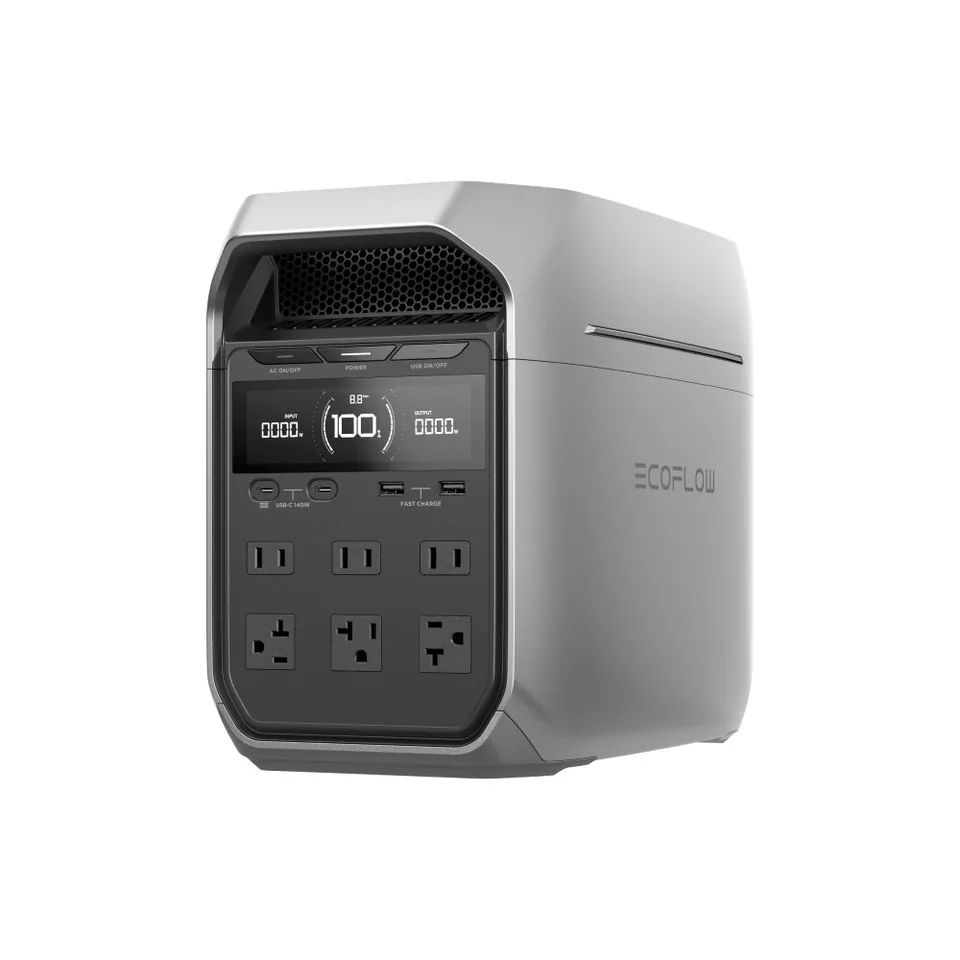
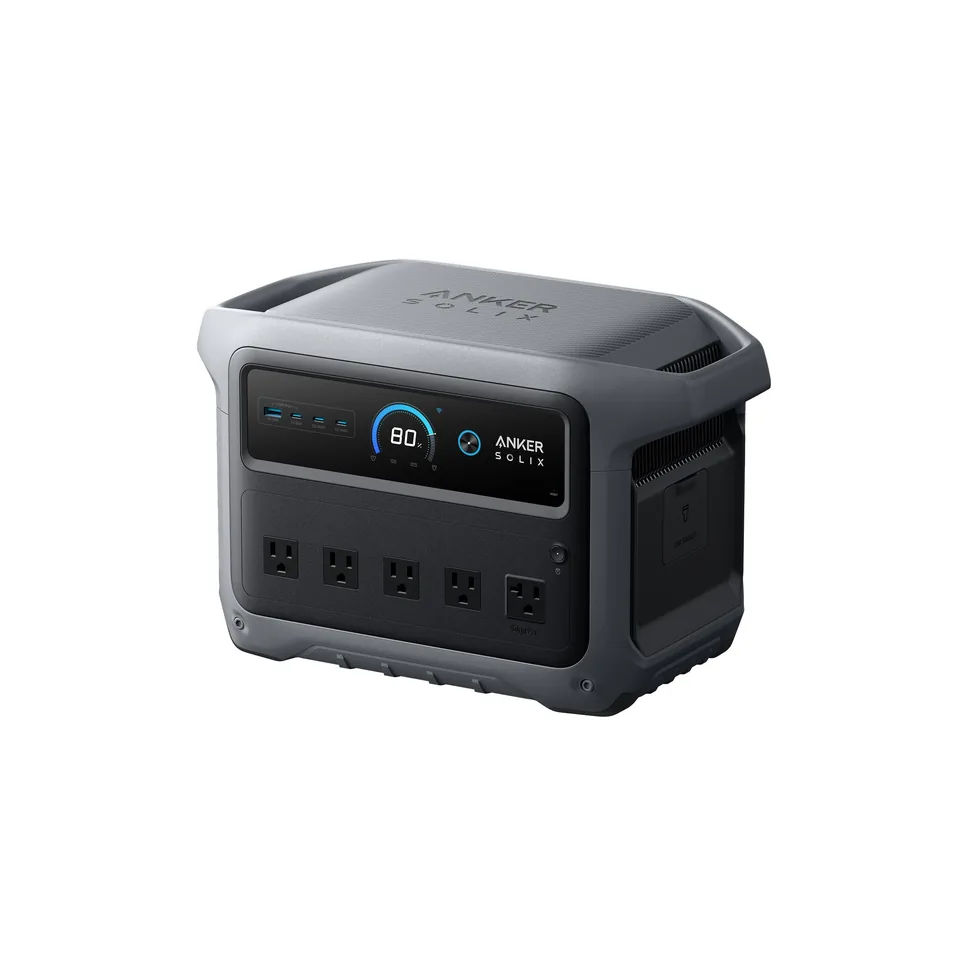
The EcoFlow has the fuller port panel: six AC outlets, three rated for 20 A plugs, two 140 W USB-C ports, two USB-A ports, a 126 W car socket and two DC5521 barrels. The Anker offers five AC outlets, two 140 W USB-C ports, a 15 W USB-C, a 12 W USB-A and a 120 W car socket. The EcoFlow also seals its battery cells to IP65 inside an IP20 case, which the Anker does not match.
Noise is a draw with an asterisk. EcoFlow quotes 30 dB at 600 W and under 40 dB at 1,200 W, the quieter published curve at everyday loads. Anker quotes 20 dB without stating a load, and OutdoorGearLab and MacRumors both call the fan loud during fast charging and near full output. Slowing the charge in the app quiets either unit.
Expansion and warranty
This is the deciding row. The EcoFlow has an extra-battery port that accepts a DELTA 2, DELTA 2 Max, DELTA 3 or DELTA Pro 3 pack, taking the system to roughly 2, 3 or 5 kWh. Only one pack can be attached, so 5 kWh means the large DELTA Pro 3 battery. The Anker Gen 2 dropped the expansion port Gen 1 had; if you outgrow it, the answer is a second station or Anker's larger C2000 line.
Both carry a five-year warranty, per EcoFlow's product page and OutdoorGearLab's spec summary for the Anker, and both rate their LFP packs at 4,000 cycles to 80 percent.
Who should buy which
Buy the EcoFlow DELTA 3 Plus if you might want 2 kWh or more later, if you own or plan to own more than 600 W of solar, if you need the sixth outlet or the 20 A sockets, or if the station will run a NAS. Keep its high-load heat in mind and plan on short bursts above 1,200 W.
Buy the Anker SOLIX C1000 Gen 2 if 1 kWh is all you will ever need, if a specific appliance sits between 1,800 W and 2,000 W, or if the extra 200 W and the lighter body matter more than solar headroom. With expansion off the table it is the sharper buy, which is also OutdoorGearLab's conclusion.
Buy the EcoFlow DELTA 3 Plus if there is any chance you will add a battery later, if you run solar above 600 W, or if you want the sixth outlet and the sealed battery module. Buy the Anker SOLIX C1000 Gen 2 if you are certain 1 kWh is the end state and you would rather have 2,000 W, a 49-minute recharge and a lighter box.