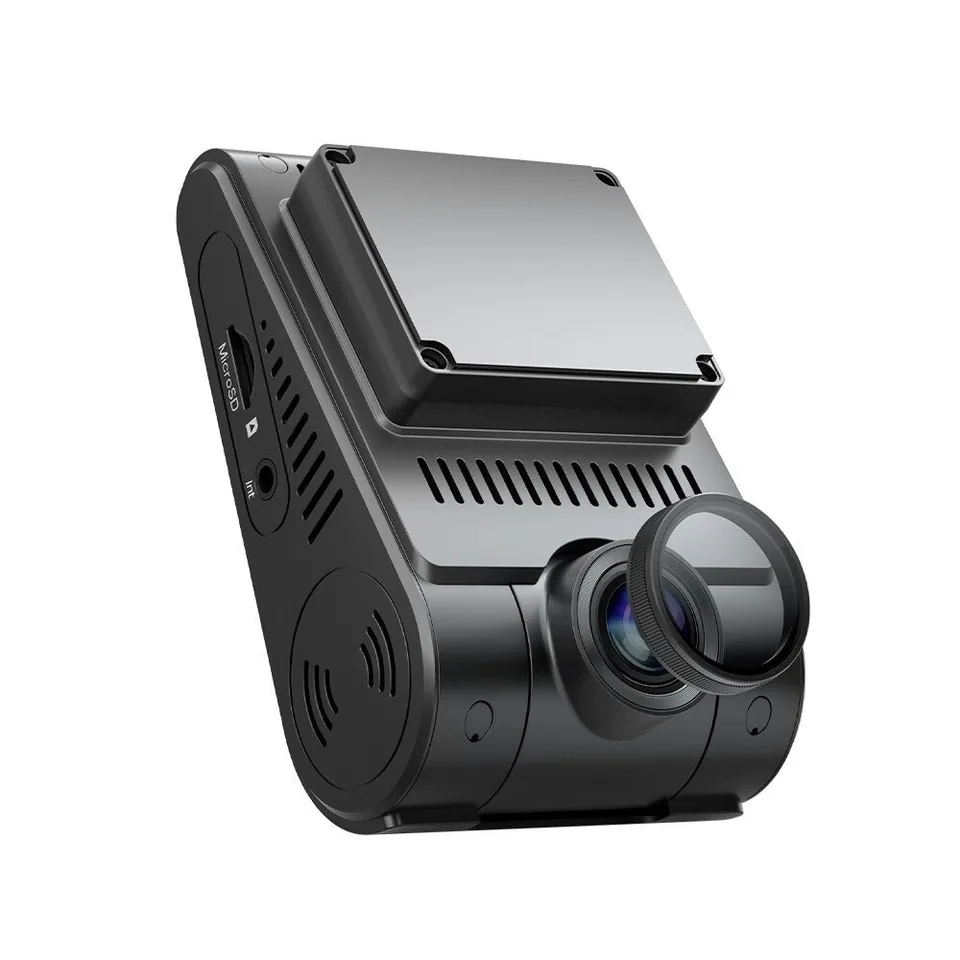
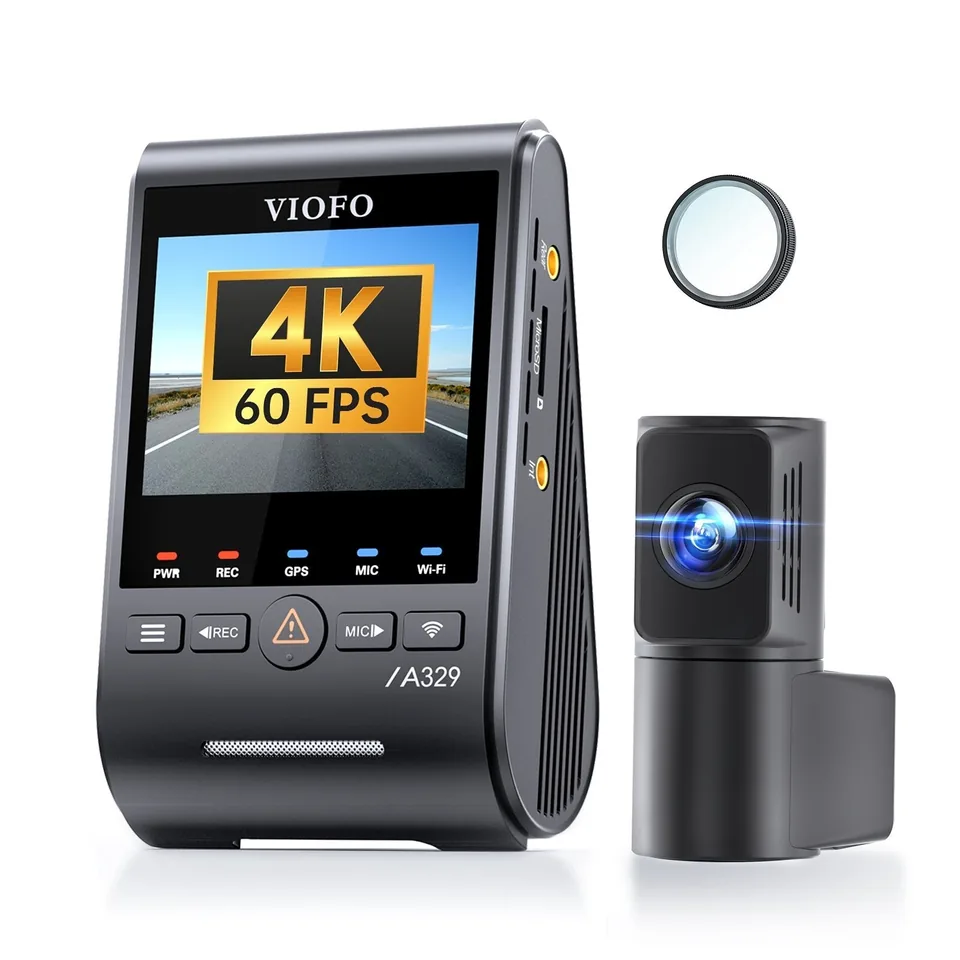
Viofo A229 Pro vs A329S: Is 4K/60 and SSD Storage Worth the Upgrade?
Both two-channel VIOFO cameras record the front on the same Sony STARVIS 2 IMX678 sensor and the rear on the same IMX675, so the footage at 4K 30 fps with HDR is close to identical. The A329S separates itself with 4K at 60 fps, Wi-Fi 6, an SSD port and a parking mode that draws a fraction of the current.
The two-channel dash cam to buy if reading plates at night is the point. It is Wirecutter's top pick, its front footage scores as well after dark as in daylight in Dashboard Camera Reviews' tests, and the accessory bundle is complete.
VIOFO's 2026 flagship, and the dash cam to buy if you park on the street for days or want 60 fps for fast-moving plates. Most drivers will be as well served by the cheaper A229 Pro; the A329S earns its premium on parking draw and storage.
The headline difference is the frame rate, and it is smaller than the spec sheet suggests. Both cameras use the same 1/1.8 in, 8 MP Sony STARVIS 2 IMX678 behind a 140-degree lens. The A229 Pro records it at 4K 30 fps with HDR and cannot go higher. The A329S has a newer Novatek processor that reaches 4K 60 fps, but HDR is available at 30 fps only; VIOFO's product page tells you to switch to 30 fps for HDR recording.
That trade matters at night. HDR is what keeps a plate legible under headlight glare, and it is the mode Dashboard Camera Reviews rated very good after dark on the A229 Pro. Run the A329S at 60 fps and you get less motion blur on a car crossing an intersection, but you give up the HDR blend after dark. Dash Cam Guys notes an AutoHDR option that runs 60 fps by day and drops to 30 fps with HDR at night, which is the sensible way to use it. Set that way, the two cameras record the same front image after dark.
Bitrate is slightly higher on the A329S, about 65 Mbps against about 60 Mbps. Dashboard Camera Reviews scored both fronts very good by day and by night.
Rear video: identical sensor, identical weakness
Both rear cameras are the 1/2.8 in, 5 MP STARVIS 2 IMX675 at 2560 x 1440, 30 fps, with HDR. Both are fine in daylight and weaker at night: Dashboard Camera Reviews rated the A229 Pro rear only fair on unlit roads and the A329S rear a step better, while DashCamTalk called the A329S rear average after dark. Neither reads a plate behind tinted glass on a dark street with confidence. If the rear view is your priority, the upgrade does not fix it.
Parking mode: the reason to pay more
This is where the two cameras stop being the same product. The A229 Pro offers buffered event detection with a 15-second pre-roll, time-lapse and low-bitrate modes. All three keep the camera awake. VIOFO's own parking-mode guide lists the draw for the A229 Pro 3CH at about 6.7 W in event detection, 6.5 W in low bitrate and 6.0 W in time-lapse. At 12 V that is roughly half an amp, which is why the HK4 kit has to cut power on a timer or voltage threshold after a day or so.
The A329S keeps those modes and adds a low-power impact mode that puts the camera to sleep with only the G-sensor listening. VIOFO states a minimum standby draw of 0.24 W, or 20 mA at 12 V, and a wake-up within two seconds. Safe Drive Solutions measured about 29 mA with one camera attached and 39 mA with two on pre-production units. Even at the measured figure, that is more than ten times less current than the A229 Pro's awake modes, which is the difference between a camera that is armed on day three and one the hardwire kit switched off on day one.
The A329S also has a hybrid mode: start in buffered detection or time-lapse, then fall back to low-power impact mode when a timer expires or the battery voltage drops. The voltage trigger requires the HK6 kit, which reports battery voltage to the camera over Bluetooth; the HK4 supports the timer only. A DashCamTalk contributor who ran both cameras called these parking modes the most useful difference between them, and that matches our reading.
Storage and transfers
The A229 Pro records to microSD up to 512 GB, which Dashboard Camera Reviews puts at roughly 13 hours of two-channel footage. The A329S takes the same card, or an external SSD of up to 4 TB over USB 3.0. VIOFO's own table runs from six days on a 512 GB drive to 46 days on 4 TB at three hours of driving a day, and the drive can be hidden elsewhere in the car. The catch is that recording goes to the SSD or the card, never both, and DashCamTalk reports compatibility problems with some drives.
Transfers are the quieter upgrade. The A229 Pro has dual-band Wi-Fi at 2.4 and 5 GHz. The A329S moves to Wi-Fi 6 with a stated peak of about 30 MB/s to a phone, roughly three times the earlier standard according to Dash Cam Guys. A minute of 4K 60 is close to half a gigabyte, so this matters the day you need to pull a clip after an incident.
What is the same
Both come with a front CPL filter in the box, quad-mode GPS, a supercapacitor rather than a battery, voice control and a 2.4 in non-touch screen. Both need a hardwire kit for any parking mode; the A229 Pro is simpler here, since one HK4 kit unlocks everything it can do, while the A329S needs the HK6 for its best trick. Both are visible units on the glass, not hidden ones.
Who should buy which
Buy the A229 Pro 2CH if your car sleeps in a garage or a driveway and most of your driving is commuting. You get the same two sensors, the same HDR night footage that made it Wirecutter's top pick, and the money saved covers a high-endurance card and the HK4 kit. It remains our top pick on the best dash cams list for exactly that buyer.
Buy the A329S 2CH if you street-park, leave the car at an airport or job site for days, or drive a hybrid or EV with a small 12 V battery that cannot feed half an amp overnight. Buy it too if you want weeks of footage on an SSD, or if fast daytime plates matter more than night HDR. Pair it with the HK6 kit, or you lose the voltage-based hybrid switching.
Skip both if you will not run a constant-power cable. Without it, neither has a parking mode, and the cheaper A229 Pro records the same driving footage.
Which one should you buy?
Buy the A229 Pro 2CH if you park in a garage or driveway, drive during the day and want the best night plates for the money; it is the same sensor pair with a simpler accessory story. Buy the A329S 2CH if you leave the car on the street for days, need weeks of footage on an SSD, or want 60 fps for plates crossing the frame at speed. The parking draw, not the frame rate, is what earns the premium.
Street parkers who want impact detection that lasts, rideshare and fleet drivers who need weeks of footage, and anyone who wants the smoothest 4K available