Peak Design 45L vs Osprey Farpoint 40: Organization or Comfort?
Both are panel-loading carry-on travel packs with a padded 16 in laptop sleeve, a harness that stows away and a lifetime guarantee. The Peak Design grows from 30 to 45 L and is packed with pockets; the 2026 Farpoint 40 is a fixed 40 L, about 1.2 lb lighter by the makers' figures, and carries on a LightWire frame with an adjustable torso.
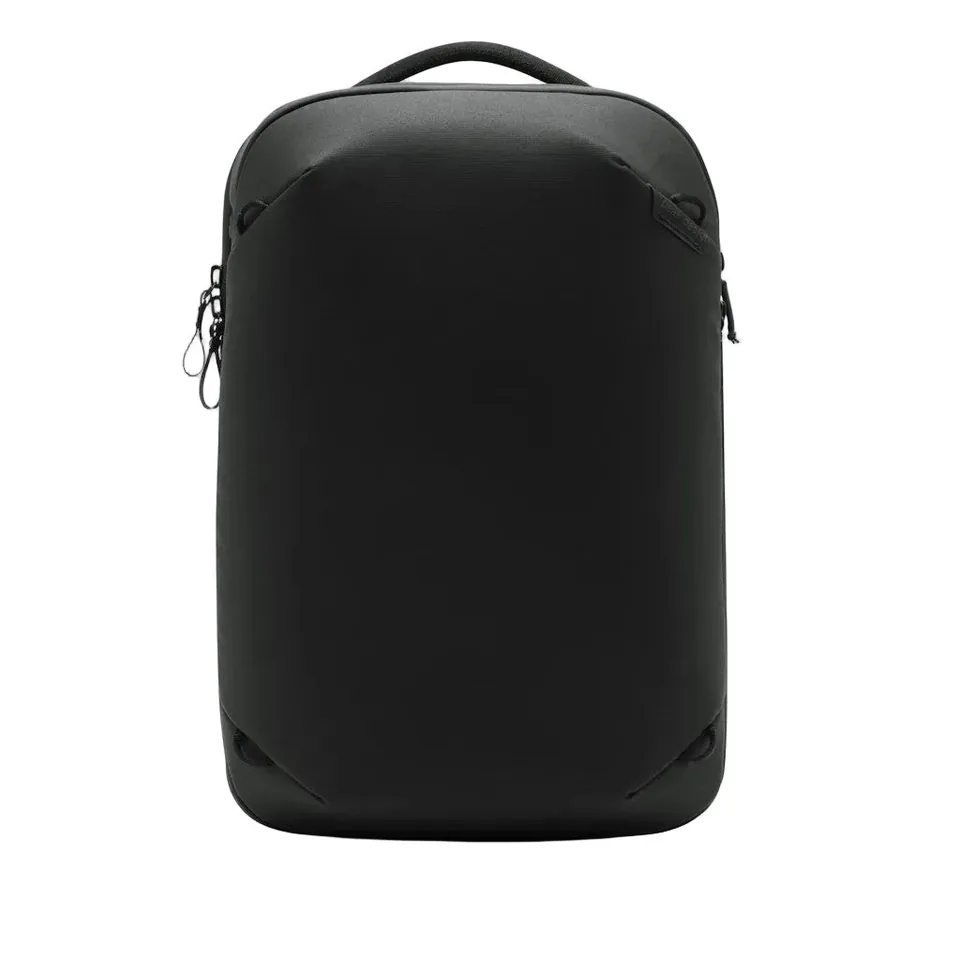
The premium one-bag pick: a weatherproof, very well organized pack that shrinks to 30 L, carries on at 35 L and expands to 45 L once you land. It is the heaviest bag on our list at 4.5 lb, and at its 35 L carry-on size it is still half an inch deeper than the US limit.
The travel backpack for people who carry their bag for hours: the 2026 Farpoint 40 keeps the LightWire frame, adjustable torso and padded hip belt that made the name GearJunkie's best carrying travel pack, and weighs less. Inside it is still mostly one open space, and no independent test of this version is out yet.
The Osprey is the lighter bag by a clear margin. Peak Design lists the Travel Backpack 45L at 2.05 kg (4.5 lb), and the testers agree: OutdoorGearLab weighed 4.5 lb, Pack Hacker 4.55 lb and GearJunkie 4 lb 8 oz. Osprey lists the 2026 Farpoint 40 at 1.48 kg (3.27 lb). That is about 1.2 lb, or 0.57 kg, less. Nobody has published a scale reading for the 2026 version yet; OutdoorGearLab weighed the previous Farpoint at 3.5 lb.
On a US domestic flight that gap only matters when you lift the bag. On an airline with a 7 kg cabin limit it decides how much you pack: the empty Peak Design leaves just under 5 kg for your things, the Farpoint about 5.5 kg.
Size favors the Osprey too. The big US carriers publish 22 x 14 x 9 in. Osprey lists the Farpoint at 21.7 x 13.8 x 9.1 in, a tenth of an inch deep on paper, and says it meets domestic carry-on requirements. Peak Design lists 22 x 13 x 9.5 in at the standard 35 L size and 11 in deep when expanded to 45 L. Its compressed 30 L mode does not help at the sizer, because Peak Design says compression only happens at the top of the bag, so the 9.5 in depth stays. OutdoorGearLab called its carry-on fit tight. Pack Hacker's airline check counts the Peak Design within the size limits of 19 of 146 airlines, against 55 for the previous Farpoint.
Harness and carry comfort
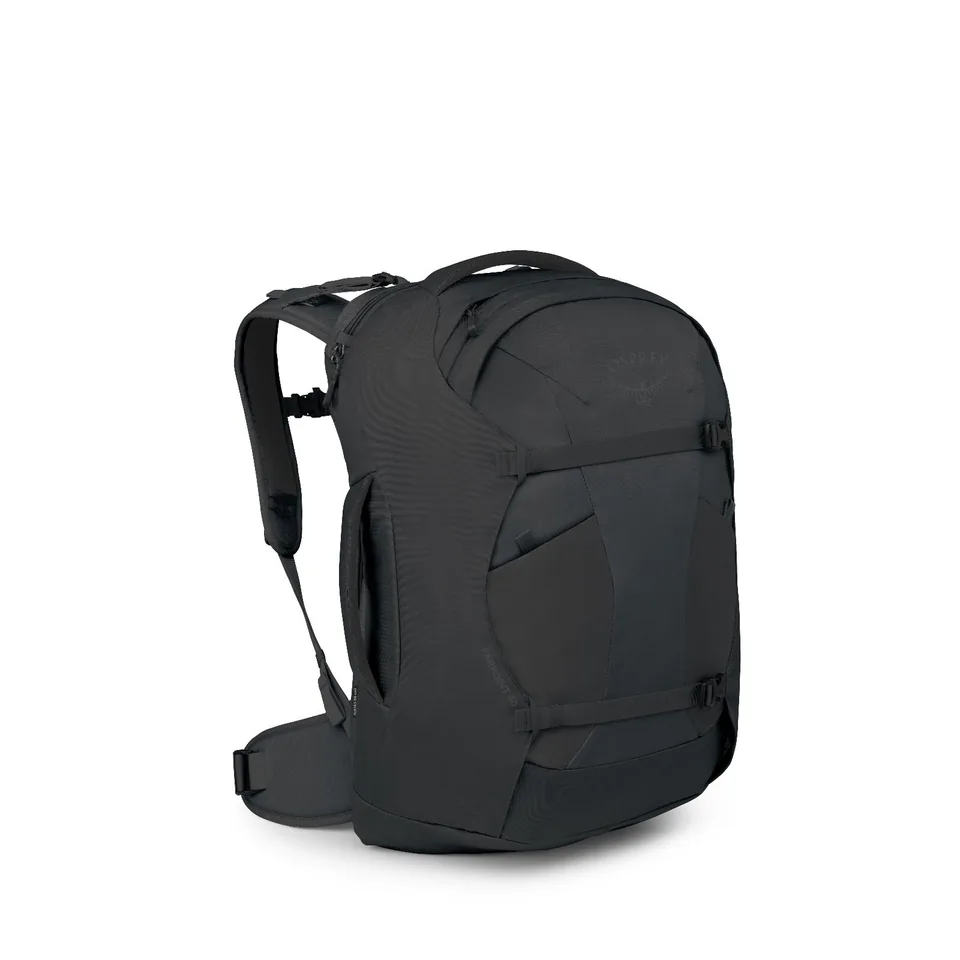
This is the Farpoint's reason to exist. Osprey builds it like a hiking pack: a LightWire peripheral frame moves the load from the shoulder straps to the hip belt, an Atilon framesheet spreads it across the back, the torso length adjusts, and a padded spacermesh hip belt wraps the hips. Osprey rates it for 7 to 16 kg, about 15 to 35 lb. On the previous version OutdoorGearLab gave comfort and fit a perfect 10 of 10, and GearJunkie called it the best load carrier of all the packs it tried.
The Peak Design has no frame. Its shoulder straps and hip belt tuck away behind the back panel. OutdoorGearLab found the hip belt well made and comfortable with about 40 lb inside, but scored comfort 7.8 of 10 and noted the thin back padding lets little air through in summer. Pack Hacker liked the padded hip belt and found the shoulder straps comfortable.
Stowing the harness is where the Peak Design wins back ground. GearJunkie found its magnetic back panels quicker than the Farpoint's zip-over cover, which needs the straps unclipped first. Both leave a clean bag for an overhead bin or a checked-bag belt.
Packing and organization
The two bags take opposite approaches. The Peak Design opens from the back panel like a clamshell and also has top, side and front access. A zippered mesh sleeve splits the main cavity in two, and GearJunkie counted a front section with five zippered pockets. It has a 16 in laptop sleeve and a separate 10 in tablet sleeve, and Peak Design says the bag holds three of its packing or camera cubes plus extra space. Camera dividers cost extra, which OutdoorGearLab flagged.
The Farpoint is mostly one open space. Osprey lists a large front-panel opening with lockable zipper sliders, a direct-zip toiletry pocket for the security line, a direct-zip sleeve for laptops up to 16 in, one zippered mesh pocket on the inside of the front flap and two internal compression straps. GearJunkie, Pack Hacker and OutdoorGearLab all marked the previous version down for thin internal organization, and nothing on Osprey's 2026 feature list changes that. Plan on packing cubes.
The trade on capacity is simpler. The Farpoint is a fixed 40 L. The Peak Design flies at 35 L and opens to 45 L once you land, which GearJunkie calls the clever part of the design; just remember the expanded bag is too deep for a carry-on.
Materials and warranty
Peak Design uses a heavier shell: recycled 400D nylon with a water-repellent treatment and a double poly coating, over a 900D waterproof bottom liner, with anodized aluminum hardware. GearJunkie scored its durability 9 of 10, and Pack Hacker reported no broken parts after six months, only light marks on the fabric.
The 2026 Farpoint moved to bluesign-approved recycled 210D nylon for the body and 420D nylon for the base, both with a water-repellent finish made without PFAS. That is part of how it got lighter. The previous version was 450D recycled polyester, which is what GearJunkie, Pack Hacker and OutdoorGearLab tested, so nobody has yet reported how the thinner nylon wears.
Both come with strong coverage. Peak Design backs the bag with its lifetime warranty. Osprey's All Mighty Guarantee says it will repair any damage or defect for any reason free of charge, and replace the pack if it cannot be repaired.
What the testers found
Read the expert results with one caveat: every published test of the Farpoint 40 so far is of the previous generation, not the 2026 bag on Osprey's US store today. With that in mind, the two land close. In OutdoorGearLab's August 2026 test the earlier Farpoint scored 76 of 100 and placed 6th of 17; the Peak Design scored 75 and placed 8th, with a Top Pick award for carrying camera gear. GearJunkie names the Peak Design its best overall travel backpack, rated 9.2 of 10, and the Farpoint its best carrying travel backpack at 8.1. Pack Hacker rates the Peak Design 8.9 and makes the earlier Farpoint its budget pick at 8.2.
Price follows the same split. GearJunkie places the Peak Design in its premium tier and the Farpoint in its mid tier, so the Osprey is the cheaper of the two. Both sit on our best travel backpacks list.
Who should buy which
Buy the Peak Design Travel Backpack 45L if you travel with a laptop, a tablet or a camera and want a place for each, if you would rather use built-in pockets than packing cubes, or if you like to fly at 35 L and expand to 45 L for the trip home. Accept the extra weight, keep an eye on depth at strict gates, and skip it if your airline weighs cabin bags.
Buy the Osprey Farpoint 40 if the bag will spend hours on your back, from a train station to a hostel or along a day of ferries and buses. The frame, the adjustable torso and the hip belt earned the earlier version top comfort marks from OutdoorGearLab and GearJunkie, it is the lighter and cheaper bag, and its depth sits much closer to the US limit. Add packing cubes, and know that the 2026 version has not been independently tested yet.
Frequently asked questions
Is the Peak Design Travel Backpack 45L carry-on size?
At its standard 35 L size it measures 22 x 13 x 9.5 in by Peak Design's figures, half an inch deeper than the 22 x 14 x 9 in the big US carriers publish. Compressing it to 30 L does not reduce that depth, and expanding it to 45 L makes it 11 in deep, so fly it at 35 L and expect a tight fit at strict gates.
Is the Osprey Farpoint 40 carry-on size?
Osprey lists it at 21.7 x 13.8 x 9.1 in and says it meets domestic carry-on requirements. That is a tenth of an inch over the 9 in depth on paper, much closer to the US limit than the Peak Design.
Which is better for one-bag travel?
It depends on how you travel. The Peak Design is GearJunkie's best overall travel backpack, with better organization, a tablet sleeve and the option to expand to 45 L. The Farpoint 40 is the better choice if you walk long distances with your bag, thanks to its frame and padded hip belt.
Which is lighter, the Peak Design 45L or the Osprey Farpoint 40?
The Osprey. Osprey lists the 2026 Farpoint 40 at 3.27 lb, while Peak Design lists 4.5 lb for its bag and three independent testers weighed it at about the same.
Do I need packing cubes for the Osprey Farpoint 40?
Most likely, yes. Inside it has a laptop sleeve, one zippered mesh pocket and two compression straps, and GearJunkie, Pack Hacker and OutdoorGearLab all found the organization thin on the previous version.
Which one should you buy?
Buy the Peak Design Travel Backpack 45L if you fly with a laptop, tablet or camera, want built-in pockets instead of packing cubes, and like a bag that expands at your destination. Buy the Osprey Farpoint 40 if you walk long distances with a full bag, fly airlines that weigh cabin bags, or want a depth closer to the US 9 in limit. Expect to add packing cubes to the Osprey.
Backpackers and rail travelers who walk long distances with a full bag and want real hip support in a carry-on size; the Fairview 40 is the women's fit