01Start with empty weight, because the airline might
On US domestic flights the big three carriers publish a size limit, 22 x 14 x 9 in, and no weight limit for the bag in the bin, so a heavy carry-on costs you nothing but effort. Outside the US the picture flips. Emirates allows 7 kg (15 lb), Lufthansa 8 kg, and most European low-cost and Asian carriers sit between 7 and 10 kg, with scales at the gate. On a 7 kg allowance the empty bag is the biggest single item you pack.
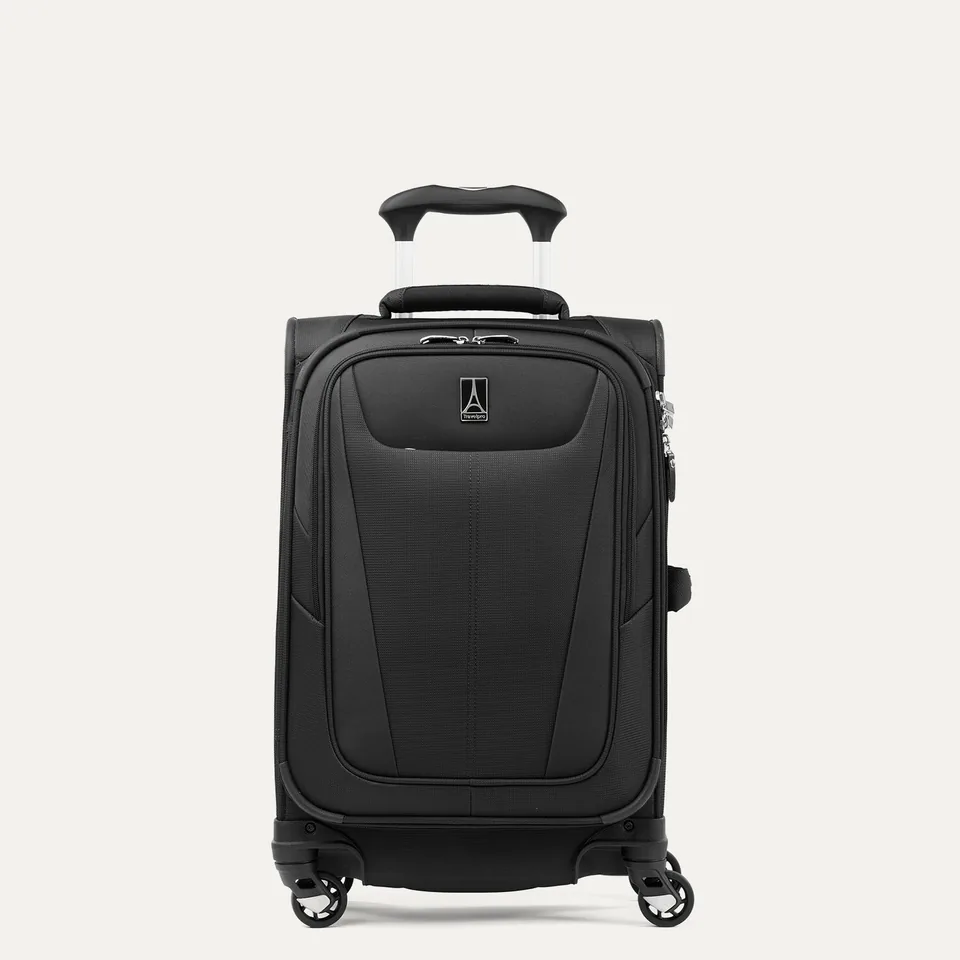
The spread between the lightest and heaviest pick is 2.4 lb, about a kilogram, which is three or four shirts. If you fly weight-limited carriers, the Maxlite 5 is the answer before any other criterion comes into it. If you fly domestic US routes, weight only matters to your shoulders. Torn between the two Travelpros? Our Travelpro Maxlite 5 vs Platinum Elite comparison goes row by row.
02Sizer fit: measure with wheels and handle, and know that only soft bags compress
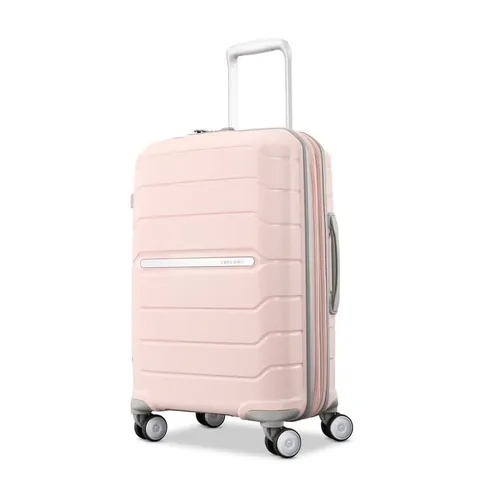
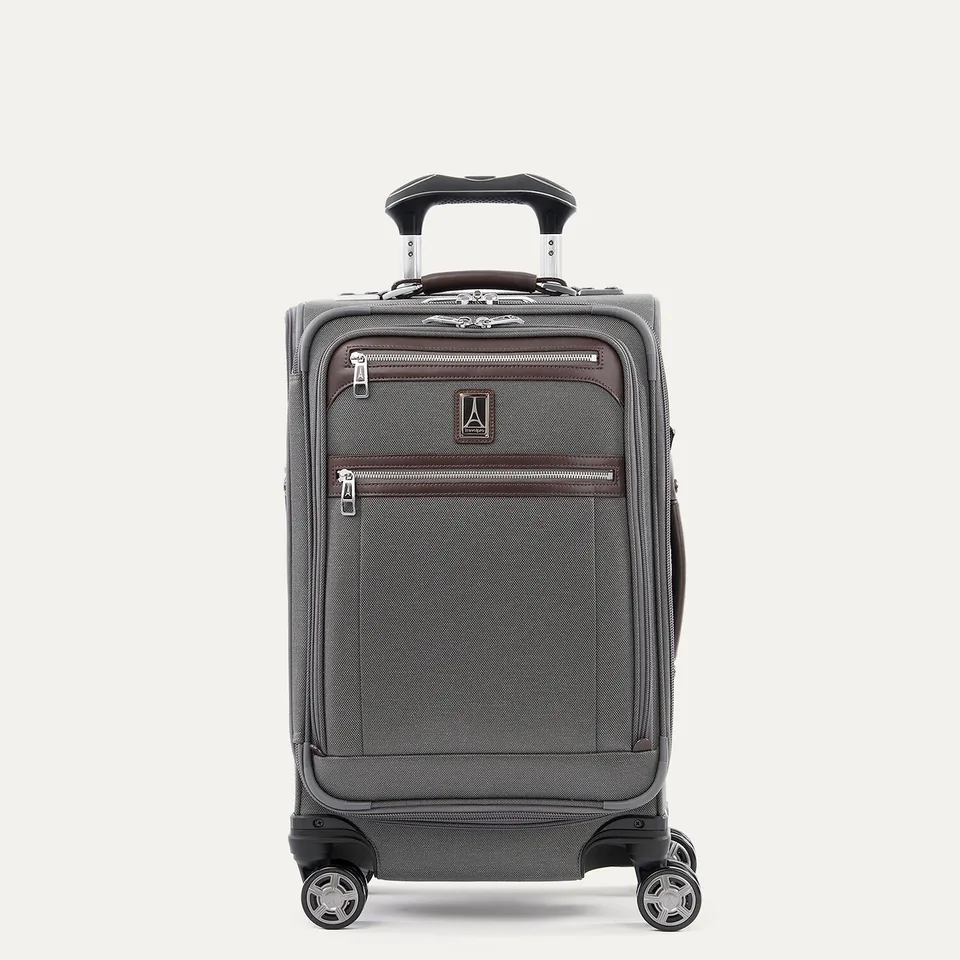
Every bag here is sold as a 21-inch carry-on, and every one is taller than 22 in once wheels and the handle housing are counted. Travelpro lists the Platinum Elite at 23.5 in and the Maxlite 5 at 23 in overall; Samsonite lists the Freeform at 23 x 15 x 10 in; OutdoorGearLab measured the Amazon Basics at 22 x 14.8 x 10 in. That is normal for the category, and most gate agents never check, but it is worth knowing which dimension is over and by how much.
The hard shells are over in width and depth as well as height, and a polypropylene or ABS case cannot be squeezed. The two Travelpros are 14.5 in wide and 9 in deep, inside the limit on both axes, and a softside gives a little when pushed into a sizer. If you fly a carrier known for measuring, or on international routes where 55 x 40 x 20 cm limits are common, the soft bags fit more often. Keep every expansion zipper closed at the gate; an expanded bag is 1 to 2 in deeper and will not fit anything.
03Hardside or softside: decide by what you need protected
OutdoorGearLab's long-running test has not found a large durability gap between the two types, and its water tests cut against intuition: the Freeform's main zipper let water in during a rain test while the Platinum Elite's coated nylon kept the interior essentially dry under a hose. What a hard shell reliably gives you is crush resistance and, on the Freeform, a lock molded into the case; what it costs you is exterior pockets, a finish that scuffs, and less expansion (about 1 in on the Freeform against 2 in on both Travelpros). Soft shells are lighter for the same body, give you outside pockets for a laptop or documents, and compress a little in a sizer; their weak points are zippers and fabric corners, which is exactly what Travelpro's warranty names.
The practical rule: if your bag gets checked at the gate often, or you carry things that should not be crushed, take the Freeform. If you work out of the bag, need a jacket to arrive flat, or fly weight-limited carriers, take a Travelpro.
04Wheels and handle: where the premium actually goes
This is what the Travelpro ladder makes visible. The two Travelpros share a body, a 46 L rating, a 2 in expansion and the same lifetime warranty. The premium buys eight self-aligning MagnaTrac wheels instead of four single ones, an aluminum four-stop handle instead of a two-stop one, a suiter, USB pass-through, and nylon with leather trim instead of polyester. OutdoorGearLab scores the difference at 92 against 67 overall, with the Platinum Elite taking a 10 of 10 for ease of transport and the Maxlite 5 drawing notes about wheel chatter and wobble when full. Whether that is worth a price class depends on how many miles of terminal you roll per year, not on looks.
The hardsides show the same pattern one rung down. The Freeform's four double wheels earned praise for quiet, stable rolling; the Amazon Basics' double wheels roll fine on floors but come with a trolley handle OutdoorGearLab called rattly and a construction score of 5 of 10.
05Warranty: read what is covered, not the number of years
The two things that break on a carry-on are wheels and handles, and the two things that break them are baggage handlers and curbs. Samsonite's ten years is long but excludes airline damage and wear. Travelpro's program names the parts that fail and, once registered, pays for repairs when an airline is at fault. That is the strongest argument for either Travelpro over the Freeform for a frequent flyer, and the strongest argument against the Amazon Basics for anyone who flies more than a few times a year.
06Capacity: the maker's liters and the tester's liters differ
Travelpro rates both its bags at 46 L; OutdoorGearLab measured 40 L in the Platinum Elite's main compartment and 36.5 L in the Maxlite 5. The Freeform measured 41.2 L and the Amazon Basics 36 L on the same bench. The lesson is to compare like with like: on OutdoorGearLab's numbers the four bags are within about 5 L of each other, and a week of clothes fits in any of them. Expansion is a reserve for the trip home, not a reason to pick one bag over another.