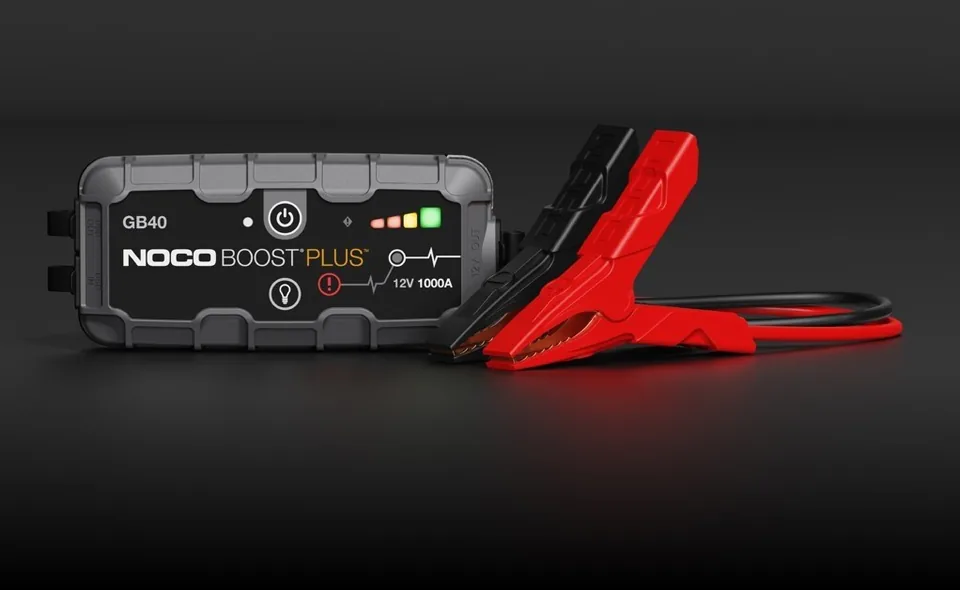
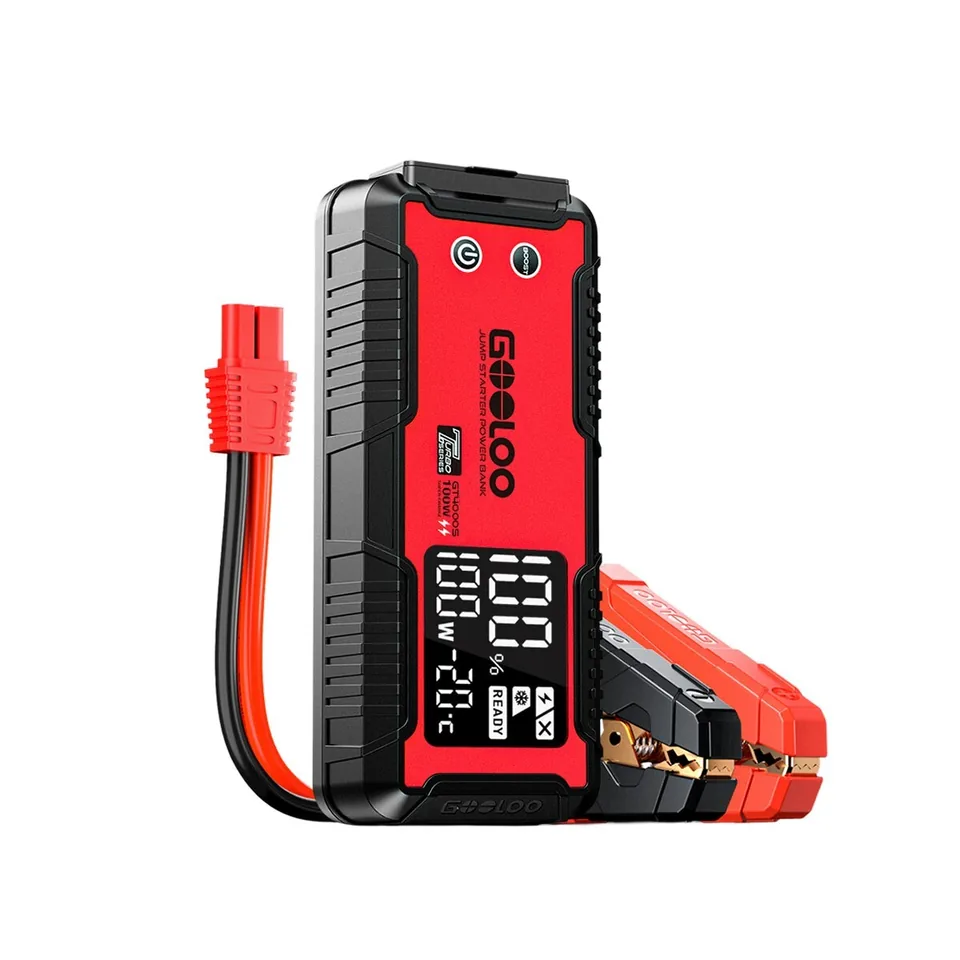
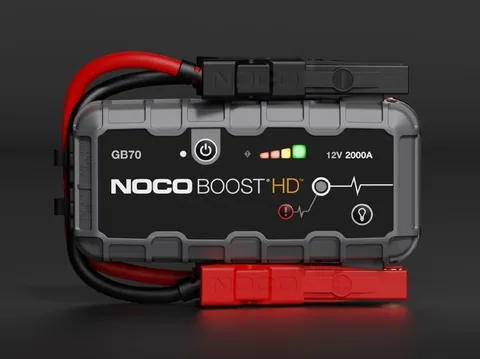
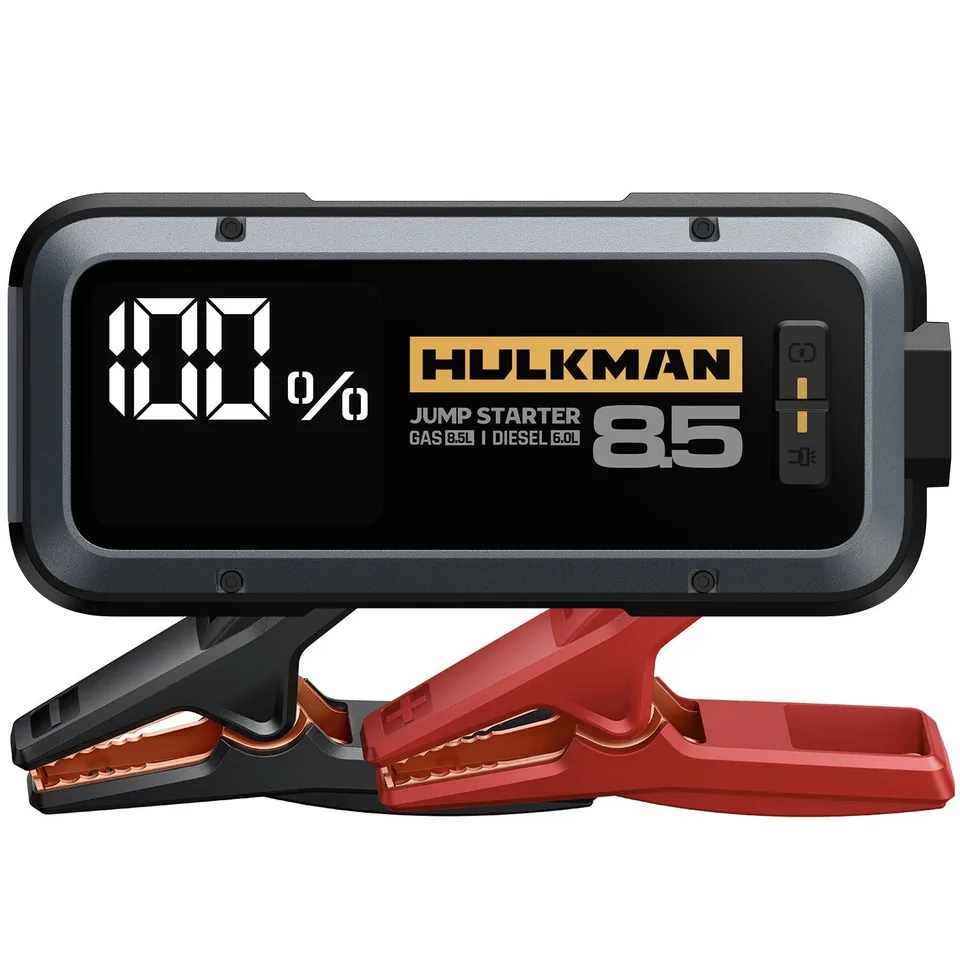
A jump starter is a lithium battery, a set of clamps and a protection circuit. The four packs here are all competent at the basic job; the differences are in how much engine they are rated for, how hard they are to misuse, and what the maker is willing to put in writing. Here is how we weighed each factor.
01Start with the engine, not the peak-amp number
The most useful line on any spec sheet is the engine rating: "gas up to 6.0 L, diesel up to 3.0 L" for the NOCO Boost Plus GB40, "gas up to 8.5 L, diesel up to 6.0 L" for the HULKMAN Alpha85, and so on. Peak-amp claims are not measured to a common standard, which is why TechGearLab tells readers to compare engine ratings rather than headline amps. A 4,000 A label on one pack and a 1,000 A label on another do not mean the first is four times as strong.
Diesels matter twice. They need more cranking current for a given displacement, so every maker rates diesel capacity at roughly half the gas figure. If you own a 3.0 L diesel SUV, the GB40 is at its limit while the GOOLOO GT4000S and the NOCO Boost HD GB70 have margin to spare. Buy for the largest engine you might need to start, including a friend's truck in a parking lot.
A rough guide from the ratings on this list:
02Clamp safety is where cheap packs fail
Every pack on this list refuses to pass current until it detects a battery connected the right way round. Reverse the clamps and you get a red light or a beeper rather than a spark; touch the clamps together and nothing happens. NOCO calls this UltraSafe, Gooloo calls it SuperSafe, Hulkman lists it among ten protection layers. It is the single feature that makes a lithium pack safe to hand to a teenager.
Clamp design is the second half. TechGearLab's testers put NOCO's thin-jaw clamps at the top of their group because they reach the recessed terminals on modern cars and grip firmly. Hulkman's clamps are adequate; we found no independent verdict on the GT4000S clamps. Short leads are a common complaint, so the pack often sits on the battery.
Both NOCOs and the Gooloo have a manual override or Boost mode that forces output when the vehicle battery is too flat for the pack to detect. That is essential on a deeply discharged battery, but it also disables the polarity check, so it belongs to whoever has read the guide.
03Look for a published safety standard
The standard that covers lithium jump packs in the United States is UL 2743, and a manufacturer that cites it is telling you the pack has been assessed for the failure modes that matter: short circuits, over-charging, and thermal runaway. An earlier GOOLOO GT4000S manual prints "conforms to UL STD.2743"; the current edition's text lacks that line, and the amazon.com listing names CE and FCC. Hulkman's support center states that all of its products are UL certified to the standard for portable power packs. NOCO does not publish a UL 2743 line for the GB40 or GB70; retailers list its packs with CE, FCC, RoHS and UN 38.3 compliance, and NOCO's protection circuitry has more years of independent testing behind it than any competitor's. We accepted both routes and rejected packs that offered neither.
04Capacity determines how many starts you get
Watt-hours, not milliamp-hours, tell you how much energy a pack holds. The GB40 has 24 Wh, the GB70 56 Wh, and the Alpha85 and GT4000S 74 Wh each (current GT4000S manual; an earlier edition lists 99.2 Wh). Bigger is better for repeated starts and for using the pack as a power bank, but TechGearLab's measurements show that usable capacity runs well below the label on some packs: about two-thirds of the claim on the GB40, and under 60 percent on one no-name 4,000 A brick they tested. Manufacturers' "starts per charge" figures (20 for the GB40, 40 for the GB70, 60 for the other two) assume small engines and a warm day.
05Recharge speed and standby
All lithium packs self-discharge, and every manual on this list says to top up every three months. Recharge speed matters when you discover the pack is flat on the morning you need it. The GT4000S is quickest, at about 1.2 hours on 100 W USB-C (a 100 W car charger is in the box), then the Alpha85 at about 90 minutes on 65 W; both makers say five minutes buys one start. The GB40 needs about 3 hours from a 2 A source, and the GB70 6 to 8 hours over USB. NOCO's 12 V fast charger cuts the GB70 to about 3 hours, but it is a separate purchase on current stock.
06Weight, weather sealing and extras
Published weights run from 2.4 lb with clamps (GB40) to 4.18 lb (GB70, about 5 lb with clamps per reviewers). Gooloo publishes none for the GT4000S; Outdoor Life lists its size as a con. All four have an IP65 housing. Extras worth having are a bright light with an SOS mode (the GB70 and GT4000S both list 400 lumens), a 12 V output for a tire inflator (GB70, GT4000S, Alpha85), and a screen that shows charge as a number (Alpha85 and GT4000S). If you also want camping or blackout power, pair a small pack with a unit from our best portable power stations list rather than buying a jump starter for its power-bank function.