Air watts, Pa and kPa are three different rulers
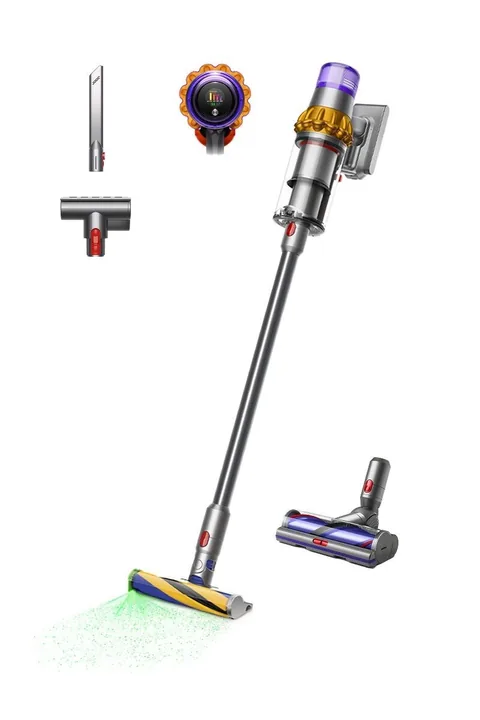
The first line on a cordless spec sheet is a suction number, and the unit tells you who made the vacuum. Dyson prints air watts: 150 on the V12, 240 on the V15, 315 on the V16. Robot vacuums and most sticks from Chinese brands print pascals or kilopascals, so a robot says 18,000 Pa and a budget stick 30 kPa. Shark prints nothing.
These are not the same measurement. Pascals describe pressure alone, how hard the motor pulls when the inlet is blocked. Air watts combine pressure with airflow, the volume of air actually moving. Pressure with no airflow behind it cleans nothing.
Nor does any standard say where to measure. A kPa figure taken at the motor, with no filter, wand or head in the way, will always beat one taken at the floor. A 30 kPa claim converts on paper to about 120 inches of water, roughly what Vacuum Wars measured on the Dyson V15, yet budget sticks on a tester's gauge land between 20 and 40 inches. Compare a manufacturer's number only with that manufacturer's other models.
Sealed suction and airflow: what the testers measure
Vacuum Wars and RTINGS put every cordless on instruments. Vacuum Wars seals the handle inlet against a manometer at maximum power and records inches of water lift, then measures airflow in cubic feet per minute at the bare wand and again with the head attached; RTINGS runs a comparable airflow bench. The ranking by measurement does not follow the ranking by air watts, as the four picks on our list show.
| Model | Box figure | Sealed suction (Vacuum Wars) | Carpet deep clean (Vacuum Wars) | Run time claimed / at Max |
|---|---|---|---|---|
| Dyson V15 Detect | 240 AW | 124 in | 100 | 60 min / 9-11 min |
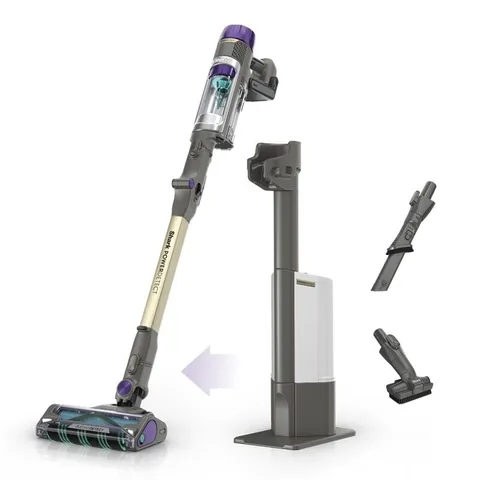
| Shark PowerDetect Clean & Empty | none | 112 in | 100 | 70 min / 13 min |
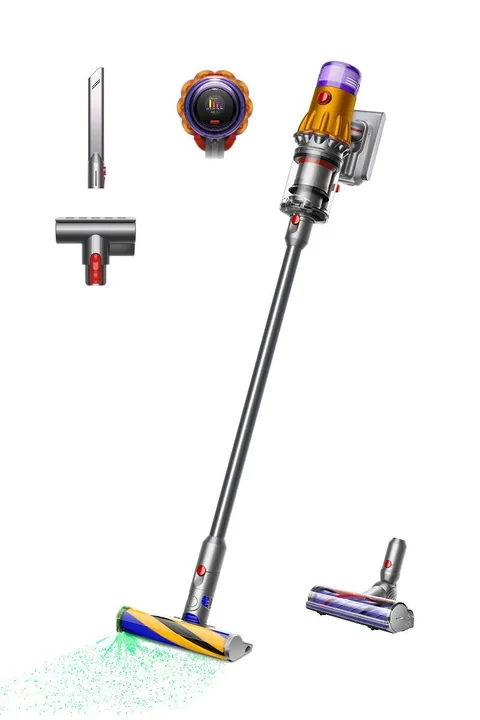
| Dyson V12 Detect Slim | 150 AW | 92 in | 96 | 60 min / 8-10 min |
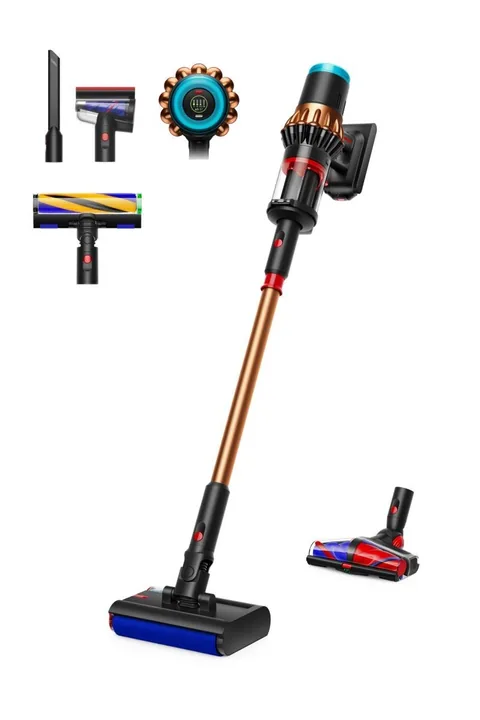
| Dyson V16 Piston Animal Submarine | 315 AW | 85 in | 100 | 70 min / 15 min |
The newest motor with the largest number posted the lowest sealed suction of the four and still scored 100 on the embedded-sand carpet test. Vacuum Wars' explanation is that past a certain point extra sealed suction stops turning into pickup; airflow at the head is what matters. Premium sticks measure around 50 to 70 CFM at the nozzle, mid-range models 30 to 49, budget sticks under 30.
Use the measurements as a floor, not a ladder. A stick under 40 inches and 30 CFM will struggle on carpet; above those lines the cleaning tests decide. Two reviewers found the V15's bristled bar cleared cereal and hair more completely than the V16's cones even though both scored 100 on sand.
The run-time claim is eco mode
Every "up to 60 minutes" or "up to 70 minutes" figure is the lowest power setting, often with no motorized head attached; Shark's 70 minutes is measured as a handvac. Nobody vacuums a house that way.
The mode you will use is Auto, where a dirt sensor raises power on debris. Independent tests put the V16 at about 40 minutes there, the Shark at 30 to 40 and the V12 at about 30. At Max, Vacuum Wars timed the V16 at 15.3 minutes with the head on, the Shark at 13, the V15 at 9 to 11 across two tests and the V12 at 8 to 10: the 70-minute machine gives you a quarter of an hour at full power. Charging takes about 4.5 hours on the Dysons and 6 by Shark's figure.
Battery chemistry, swappable packs and the year-four question
Every current stick runs a lithium-ion pack. Run time fades with charge cycles, and packs commonly need replacing in their third to fifth year, so the battery is a consumable. Two lines on the sheet decide how painful that is.
First, does the pack clip off. Dyson's V11, V15, V16 and Outsize use a click-in battery released by a button, no tools, which also lets you keep a charged spare. The V12's pack is removable but not interchangeable with other models; the Shark's comes out without tools. A screwed-in pack is an expiry date.
Second, does the maker sell the pack. Dyson and Shark list genuine replacements on their own sites. Third-party packs claiming more capacity than the original were not designed for the charger; the safety section explains why that matters.
Sealed HEPA versus a HEPA filter
"HEPA" on a box can mean the exhaust filter is HEPA-grade, or that the whole air path from head to exhaust is gasketed so nothing bypasses the filter. Only the second keeps fine dust out of the room.
The test is visual. Vacuum Wars fills the bin with fog of roughly five-micron particles and watches the machine against a black background; fog from a seam or filter door is a fail. The V15, V16 and Shark all passed, including the Shark's dock, and TechGearLab's particle counter found excellent results on the V15 and V12. Look for "sealed system" rather than HEPA alone.
Brushrolls and pet hair
The head does the cleaning; the motor supplies it. Four designs are worth buying:
- A soft roller for hard floors, which lifts fine dust and large debris without scattering. The V15 and V12 add a laser so dust shows in the beam.
- A bristled bar with de-tangling combs for carpet; the V15's Digital Motorbar is the reference.
- A dual roller, soft in front and bristled behind, for both floors; the Shark's also collects on the backstroke.
- Tapered cones, on the V16, which feed long hair toward the narrow end and into the airflow.
For a shedding dog on carpet, the bristled bar or the dual roller; reviewers found the V15's and Shark's rollers still clear after weeks of fur. For long hair on hard floors, the cones did the same at two multi-week reviews, though Vacuum Wars scored the V16 only 7 of 10 on its hair test. A head without combs or a cone needs scissors eventually.
Weight in hand versus weight on the box
The box quotes the complete stick: 5.2 lb for the V12, 6.8 for the V15, about 7.5 for the V16, about 8 for the Shark. Your wrist feels the handle, where the motor, bin and battery sit. Vacuum Wars weighs it separately: 1,480 g for the V12, 1,804 for the Shark, 2,069 for the V15 and 2,158 for the V16, against a cordless average of about 1,500.
The Shark is the heaviest complete stick but lighter in the hand than either big Dyson. For stairs and upholstery, handle weight and a button instead of a held trigger decide whether the vacuum comes out; on floors, weight buys pickup.
Bins and auto-empty docks
Hand-emptied bins run from 0.38 L on the V12, which fills in one session in a big house, to 0.77 L on the V15. The V16's bin is 0.4 L, but a lever compresses the load so about 1.3 L fits, though CHOICE found sand does not compress.
An auto-empty dock sucks the bin out when you park the stick. The Shark's bagless base holds 2 L for about 45 days; Dyson's Auto-empty Dok for the V16, a separate bundle, holds 2.5 L for up to 60 days. The costs are a base about four feet tall, about 85 dB when the Shark empties, and a heavier stick. If emptying is not what stops you vacuuming, the V15's bin is a few seconds at the trash can.
Battery safety rules out the no-name tier
The hazard in a cordless vacuum is a lithium-ion pack charging unattended in a hallway. In April 2025 the CPSC told owners of INSE S6P Pro and S6T sticks to stop using them and dispose of them as hazardous waste after 23 reports of packs overheating, melting or igniting, including at least 10 fires; the importer never agreed to a remedy. In July 2026 Rowenta recalled about 3,660 X-Force Flex 14.60 and 15.60 Animal sticks for the same failure mode, after two US reports and 65 more worldwide, and is sending free replacement packs.
The difference between those outcomes is a brand with a US address. Three checks follow. Look for a UL or ETL listing mark on the charger and pack; UL 2595, the standard for battery-powered appliances, covers exactly this fire risk. Buy from a maker that sells its own replacement battery, because a company that will sell you a pack in year four can be found in year one. And skip the unbranded sticks that reappear under a new name each season, whatever the kPa figure says; this site does not list them.
A short decision path
- Rule out anything without a sealed system, a removable manufacturer battery and a listed charger.
- Mostly carpet, or a shedding pet: the V15 or the Shark, both perfect on the deep-clean test. The Shark if you want the bin emptied for you; the V15 for the lighter stick and the laser.
- Mostly hard floors, long hair, a big house: the V16, for run time, the compressing bin and the cones.
- Stairs, an apartment or a wrist that objects to 6.8 lb: the V12.
- If the floors should clean themselves, see our robot vacuum and mop combos.
The full comparison is in the best cordless stick vacuums.
All 14 sources
- vacuumwars.com /cordless-vacuum-tests-and-scoring
- vacuumwars.com /vacuum-wars-best-cordless-vacuums
- vacuumwars.com /dyson-v15-detect-review
- vacuumwars.com /dyson-v16-piston-animal-submarine-review
- vacuumwars.com /dyson-v16-piston-animal-launch
- vacuumwars.com /dyson-v12-detect-slim-review
- vacuumwars.com /is-the-shark-powerdetect-clean-and-empty-any-good
- bestcordlessvacuumguide.com /airflow-vs-suction-guide
- techgearlab.com /reviews/floor-cleaning/cordless-stick-vacuum/dyson-v15-detect
- sharkninja.com /shark-cordless-powerdetect-clean-empty-system/IP3251.html
- dyson.com /support/journey/tools/970938-01
- cpsc.gov /Warnings/2025/CPSC-Warns-Consumers-to-Immediately-Stop-Using-INSE-Cordless-Stick-Vacuums-Due-to-Fire-and-Burn-Hazards-Risk-of-Serious-Injury-and-Death-Sold-on-Amazon-com
- cpsc.gov /Recalls/2026/Rowenta-Recalls-Cordless-Vacuum-Cleaners-Due-to-Risk-of-Serious-Injury-from-fire-and-Burn-Hazards
- webstore.ansi.org /standards/ul/ul2595ed2026