An 8-inch chef's knife does most of the cutting in most kitchens, and all four picks do it well. What separates them is character, not quality: blade thickness, steel hardness, weight and where it sits, whether a bolster helps or hinders, and how the handle behaves when wet. Settle those five things and the choice makes itself.
01German forged or Japanese thin-edge
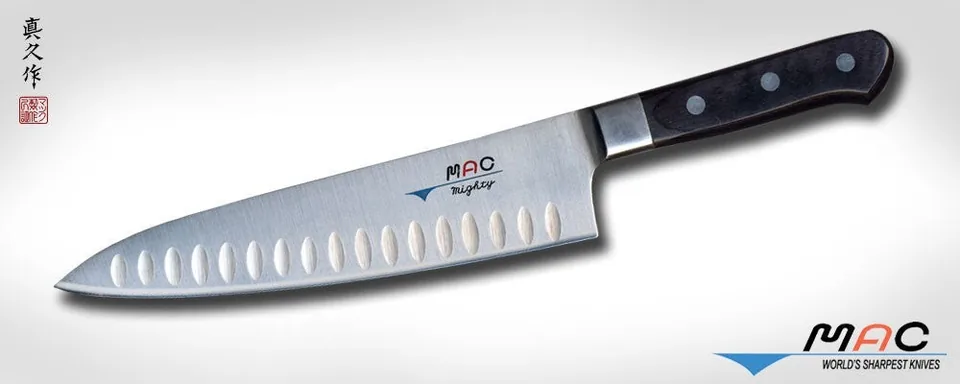
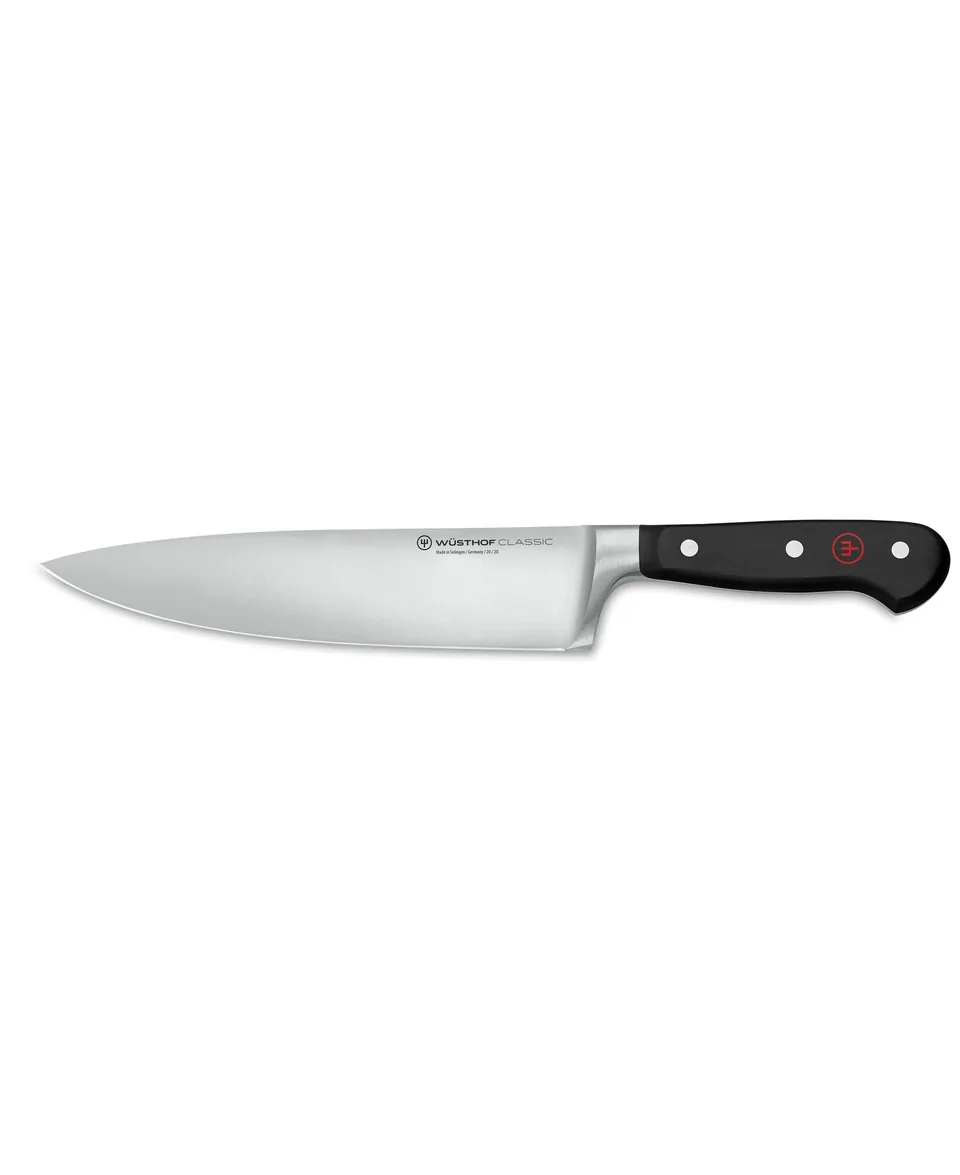
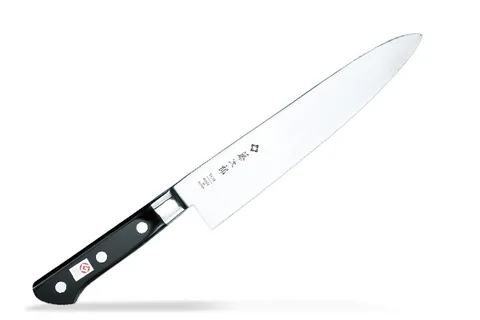
A forged German knife is shaped from a single blank, which leaves a thick spine, a full bolster and a curved belly for rocking cuts. The Wusthof Classic is the model of the type: TechGearLab measured 2.60 mm at the spine and 258 g, and Wusthof hardens the steel to a stated 58 HRC. A Japanese-style knife is ground thinner and harder with a flatter profile meant for push cuts. The Tojiro DP F-808 measured 1.90 mm at TechGearLab and the MAC MTH-80 2.10 mm, and both are rated around 60 HRC on paper.
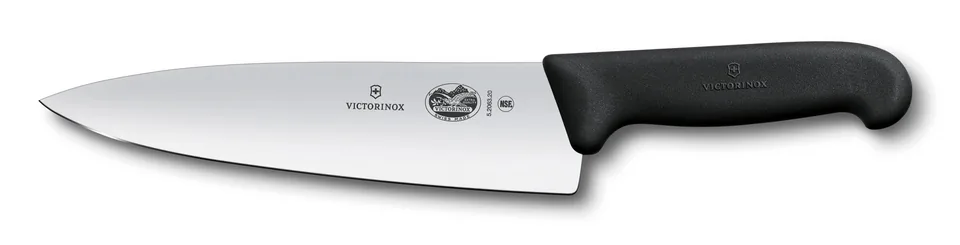
Thickness is what you feel in a carrot or a sweet potato: a thin blade slides through, a thick one wedges and needs force. The MAC and the Tojiro both put Japanese blades on Western riveted handles, so there is no D-shaped or octagonal grip to adapt to. The stamped Victorinox Fibrox Pro sits between the camps: thin and light like a Japanese knife, soft and forgiving like a German one.
Stated figures are the manufacturer's unless noted; measured figures are TechGearLab's, which tested the Victorinox Swiss Classic rather than the Fibrox Pro.
02Steel hardness: edge retention against ease of sharpening
Rockwell hardness predicts how long an edge lasts and how much work it takes to restore. The Victorinox at roughly 55 to 56 HRC dulls soonest but comes back with a few strokes on a rod or a cheap pull-through without chipping. The Wusthof at a stated 58 is a step up. The MAC and the Tojiro, around 60 on paper, hold an edge for months in owner reports, but they want a whetstone: Kitchen Knife Scout's summary of Wirecutter's advice for the MAC is a stone or a ceramic-wheel pull-through only, since carbide pull-throughs can damage the harder steel, and Knifewear's care notes for the Tojiro rule out bones and frozen food.
Treat every HRC figure as a ranking, not a measurement. TechGearLab got 53 for the MAC against a claimed 60, 54 for the Wusthof against 58 and 51 for the Tojiro against 59.5. The ordering held in use: the MAC kept its edge best in that test and the Wusthof held up through months of chopping. TechGearLab's BESS readings of factory sharpness (lower is sharper) ran from 124 for the Tojiro through 140 for the Wusthof and 187 for the MAC to 213 for the Victorinox Swiss Classic, and all are sharp enough out of the box.
03Weight and balance point
The spread is wide: 6.4 oz for the Victorinox, 6.5 oz for the MAC, about 7 oz for the Tojiro and 9.1 oz for the Wusthof. Two and a half ounces sounds trivial and is not. TechGearLab's testers with smaller hands or shorter stature found the Wusthof overly heavy at times, though the roundup also found it comfortable across many hand sizes, and Kitchen Knife Scout's summary of Wirecutter says the Classic's extra bulk is something some cooks prefer and others find fatiguing.
Balance point decides how the weight feels. The Wusthof's full bolster and thick tang pull the balance back into the hand, which makes a heavy knife feel steady. The MAC's small bolster puts the balance near a pinch grip, and TechGearLab praised its balance for such a light knife; a Tojiro owner on Kitchen Knife Forums reports that the F-808 balances just in front of the bolster, right where a pinch grip sits. The Victorinox has no bolster, so the balance sits slightly forward and the knife feels nimble rather than planted. Lighter is kinder to the wrist over a long prep; the Wusthof's mass helps with proteins.
04Bolster or no bolster
A bolster is the thickened steel between blade and handle. A full bolster like the Wusthof's runs all the way to the edge; it acts as a finger guard and adds heft, but it blocks the heel from reaching a whetstone, so after years of stone sharpening the edge in front of it recedes and leaves a step. The Sharp Kitchen lists the trickier heel sharpening among the Classic's weaknesses, and it is why Zwilling's Pro line uses a curved bolster and Misen a sloped one.
The MAC and the Tojiro have small bolsters that stop short of the edge, so the whole edge reaches the stone and the joint stays sealed against grime, which is Tojiro's stated reason for fitting one. The Victorinox has none, which keeps it light and cheap but leaves nothing to stop a slipping finger. If you sharpen on stones, avoid a full bolster; if you use a rod, a hand-held or an electric sharpener, all of which Wusthof endorses, the bolster costs you nothing.
05Handle grip when wet
The Victorinox's Fibrox thermoplastic elastomer is the reason restaurants buy it: it is textured and slightly tacky, Kitchen Knife Scout's summary of Wirecutter singles out its wet grip, and TechGearLab found the same style of handle on the Swiss Classic a real help with wet or greasy hands. The Wusthof's synthetic handle stayed secure when wet in TechGearLab's testing and scored 9.5 of 10 for ergonomics. The MAC's Pakkawood is smooth but well shaped; its issue is length, since TechGearLab found the short handle pushes every hand into a pinch grip. The Tojiro's laminate handle is boxy, and owners with big hands on Kitchen Knife Forums like it for that reason.