Tojiro · Chef's knife
Tojiro DP Gyuto 210 mm (F-808)
The F-808 is the Japanese knife to buy if you want a hard VG-10 edge and a thin grind on a modest budget and can live with a plain handle and some cosmetic wear. Rock-choppers, bone-cutters and anyone without a whetstone should pick the Wusthof or the Victorinox instead.
Ad disclosure: we earn a commission on Amazon links, at no cost to you. It never decides our picks. How this works
Photos
Pick it ifCooks who want real Japanese steel and geometry at a mid price and are willing to use a wooden board and a whetstone
Skip it ifCooks who rock-chop, cut through bones or frozen food, or want a refined handle and finish
At a glance
What stands out
- VG-10 core clad in 13-chrome stainless, listed at 60 HRC by Chef Knives To Go and Nothing But Knives; holds an edge far longer than 55 to 58 HRC German steel
- Thin grind: 2 mm at the heel per Chef Knives To Go, 1.90 mm measured by TechGearLab, the thinnest knife on our list
- Keenest factory edge in TechGearLab's 13-knife test at 124 BESS
- Full tang, three rivets and a metal bolster that Tojiro says keeps grime out of the handle joint; made in Tsubame-Sanjo, Niigata
- Bevel and Bone's value upgrade: the biggest jump in cutting performance per dollar in its 2026 guide
Flaws to know
- Handle and cladding are functional, not refined; owners report easy scratching and a boxy grip
- TechGearLab scored it 69 of 100 and found edge retention and handle control below the MAC's
- Flatter profile suits push cuts, not the rocking motion of a German knife
- Reported weight ranges from 5.6 oz to 7.2 oz across sources; we use Chef Knives To Go's 204 g
Key specs
- Blade length
- 210 mm (Tojiro); 212 mm per Chef Knives To Go; sold as 8.2 in
- Blade height
- 44 mm (Chef Knives To Go); 43.7 mm (Knifewear)
- Overall length
- 335 mm (Tojiro); 340 mm per Chef Knives To Go
- Weight
- 7.2 oz / 204 g (Chef Knives To Go); 200 g (Tojiro); 193 g measured by TechGearLab
- Blade thickness
- 2 mm at the heel (Chef Knives To Go); 1.90 mm measured by TechGearLab
- Steel
- VG-10 core, 13-chrome stainless cladding, three-layer construction (Tojiro)
- Hardness
- 60 HRC (Chef Knives To Go, Nothing But Knives); 60 to 62 HRC (Knifewear); 51 HRC measured on one sample by TechGearLab
- Edge and handle
- Double bevel, even grind; black reinforced laminated (Micarta) Western handle, full tang, three rivets, metal bolster
- Made in
- Tsubame-Sanjo, Niigata, Japan (Knifewear, Chef Knives To Go)
Who it's for
The F-808 is the Japanese knife for a cook who has read about VG-10 and thin grinds and wants to try one without moving into the Shun or MAC price class. Tojiro laminates a hard VG-10 core between two layers of softer 13-chrome stainless, grinds it thin, and fits a plain Western handle. It is the value upgrade in Bevel and Bone's July 2026 guide, which calls it the biggest jump in cutting performance per dollar in the category, and it is the knife that kitchen-knife forums have sent beginners to for years; a Kitchen Knife Forums thread from 2014 already treats it as the standard first gyuto.
Tojiro now sells the DP line as Tojiro Classic. Chef Knives To Go's listing says the knife was formerly called the DP, Knifewear lists it under the Classic name, and the F-808 model number carries over, so you will see both names on listings for the same knife.
It is the mid-budget thin-edge pick on our list of the best chef's knives: harder and thinner than a German knife, a price class below the MAC, plainer than both.
What stands out
The steel is the point. VG-10 takes a fine edge and, at the 60 HRC that Chef Knives To Go and Nothing But Knives list (Knifewear gives 60 to 62), holds it far longer than the 55 to 58 HRC steels in the Victorinox and the Wusthof. The 13-chrome cladding protects the core and makes the blade easier to sharpen than solid VG-10 would be, because only the thin core at the apex is hard. Nothing But Knives, in a review updated November 2025, found the knife ships sharp and holds its edge better than many other VG-10 knives, and credits the heat treatment.
The grind is thin. Chef Knives To Go lists 2 mm at the heel, Knifewear 2.1 mm and Nothing But Knives 1.9 mm; TechGearLab measured 1.90 mm, the thinnest of the four knives on our list. The factory edge was the keenest TechGearLab recorded in its 13-knife test, 124 on the BESS scale, though Kitchen Knife Forums members report a ground rather than polished factory edge that improves noticeably on whetstones.
Owners in that thread describe edge retention measured in months between sharpenings. Reports of VG-10 chipping are disputed there too; members say the steel holds up as long as it stays away from bones and twisting cuts, and that chipping stories may come from the rough factory edge rather than the steel.
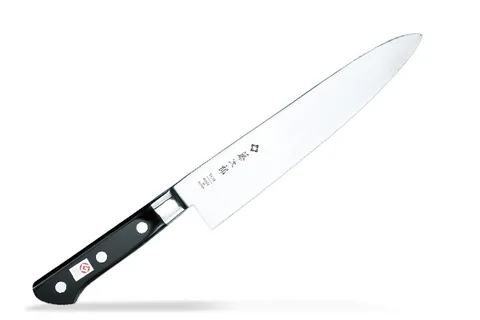
The handle is a black laminate, reinforced laminated material to Tojiro and Micarta to Chef Knives To Go, riveted through a full tang, with a metal bolster that Tojiro says keeps grime out of the joint. The knife is made in Tsubame-Sanjo, Niigata, and the design won Good Design and Long-Life Design awards in 1996.
Where it falls short
Fit and finish are functional, not refined. Nothing But Knives says the handle's looks do not match the blade, though it found it comfortable in use; forum owners call it boxy, which those with larger hands like, and note that the cladding scratches easily. The Sharp Kitchen's 2026 guide adds that the knife is no longer the bargain it once was, and that the harder edge wants good boards and technique.
Weight is reported inconsistently. Chef Knives To Go lists 7.2 oz (204 g), Tojiro's own page 200 g, Knifewear 198 g and TechGearLab's measurement 193 g; Nothing But Knives gives 5.6 oz, out of step with the rest. We use Chef Knives To Go's figure: about 7 oz, a little heavier than the MAC and well under the Wusthof.
TechGearLab scored it only 69 of 100, finding that its edge did not hold as well as the MAC's and that the handle gave less control; its hardness reading, 51 HRC against a claimed 59.5, was the widest gap in the group. The hard edge also asks for care: wooden or plastic boards, no bones, no frozen food and no dishwasher, as Knifewear spells out, and a Kitchen Knife Forums member advises against rock-chopping because of the flatter profile.
How it compares
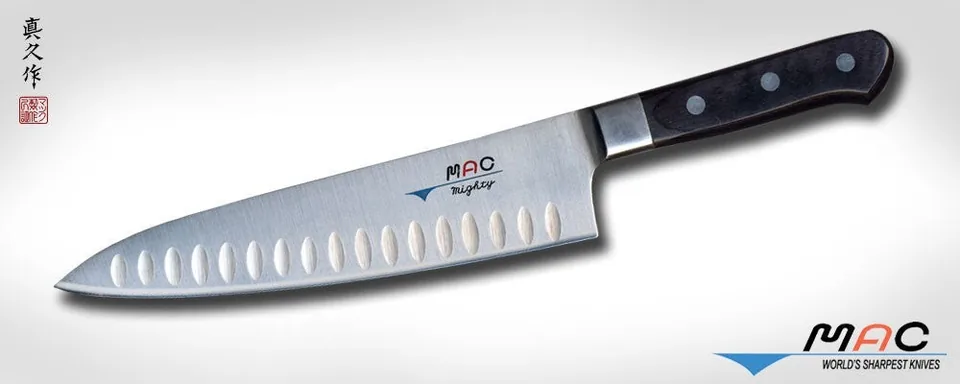
Against the MAC MTH-80, the Tojiro is close on paper: similar thickness and hardness class, both with Western handles and small bolsters. The MAC has the dimples, the better-finished handle and the longer track record at Wirecutter; the Tojiro sits in a lower price class and delivers most of the cutting.
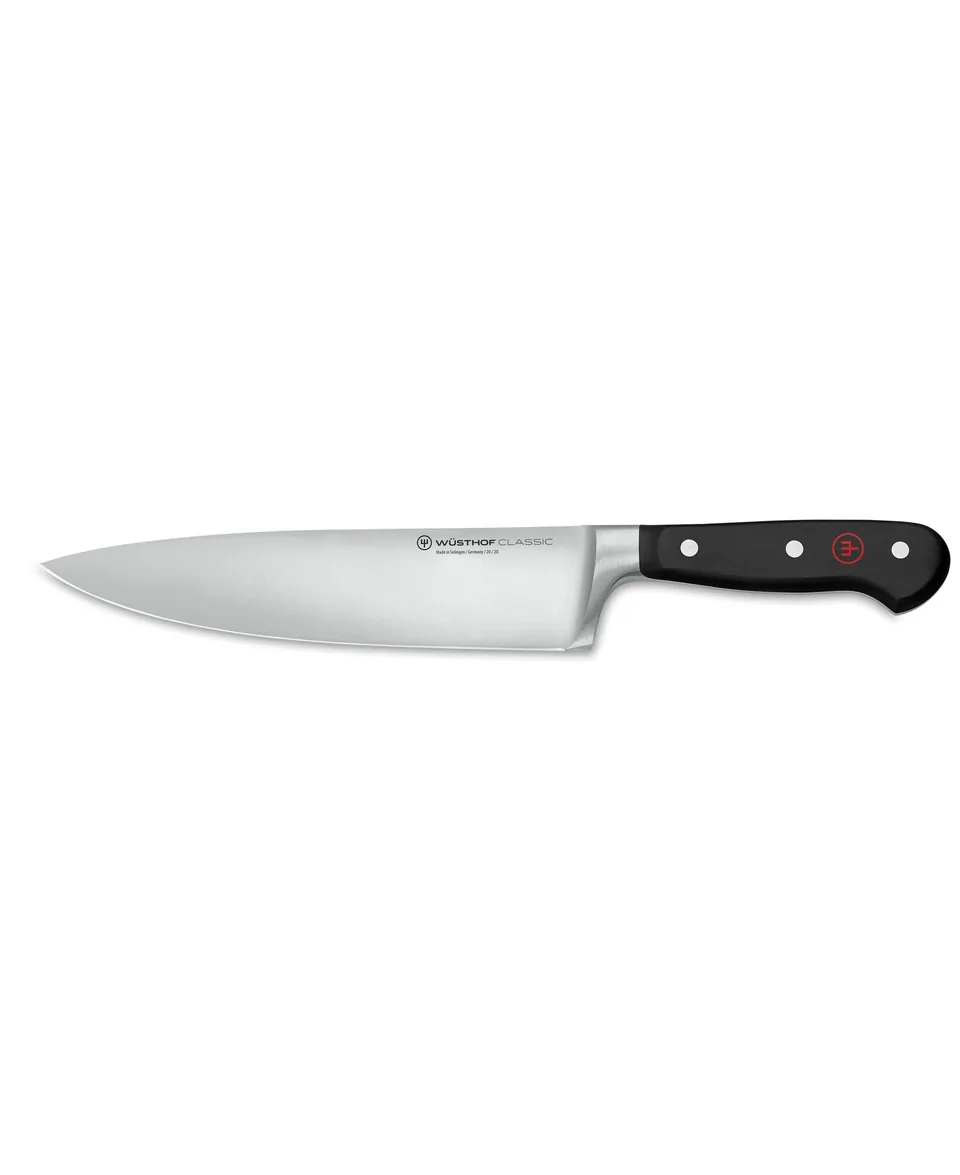
Against the Wusthof Classic, the Tojiro is about 2 oz lighter, 0.7 mm thinner by TechGearLab's measurements and a couple of HRC points harder on paper. It cuts better through dense vegetables and holds an edge longer; the Wusthof tolerates abuse, rocks better and can be sharpened on anything.
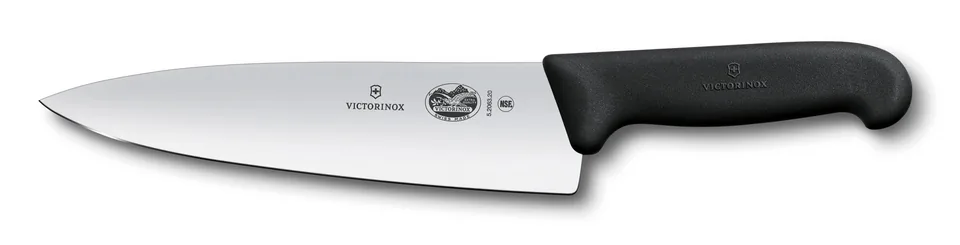
Against the Victorinox Fibrox Pro, the Tojiro is the step up for the cook who has outgrown the Victorinox's edge life and is willing to learn a stone.
Verdict
Buy the F-808 if you want real Japanese steel and geometry on a modest budget and can live with a plain handle and some cosmetic wear. It is the best cutting per dollar on our list. Skip it if you rock-chop, cut through bones, or will not keep a whetstone.
All 8 sources
- tojiro-japan.com /products/tojiro-vg10-clad-steel-with-bolster-chef-knife-210mm
- chefknivestogo.com /tojiro-dp-f-8081.html
- knifewear.com /products/tojiro-dp-gyuto-210mm-f-808
- nothingbutknives.com /tojiro-dp-gyutou-f808-chefs-knife-quick-review
- techgearlab.com /topics/kitchen/best-chef-knife
- bevelandbone.com /blog/best-chef-knives-2026
- thesharpkitchen.com /best-chef-knives
- kitchenknifeforums.com /threads/first-impression-tojiro-dp-210-gyuto.20060
The other picks in Chef's Knives
Compare all 4-
Best overall
MAC Professional Series 8-Inch Chef's Knife with Dimples (MTH-80)
Check price on Amazon(paid link) for MAC Professional Series 8-Inch Chef's Knife with Dimples (MTH-80) (opens in a new tab) -
Best budget
Victorinox Fibrox Pro 8-Inch Chef's Knife (5.2063.20)
Check price on Amazon(paid link) for Victorinox Fibrox Pro 8-Inch Chef's Knife (5.2063.20) (opens in a new tab) -
Best premium
Wusthof Classic 8-Inch Chef's Knife (1040100120)
Check price on Amazon(paid link) for Wusthof Classic 8-Inch Chef's Knife (1040100120) (opens in a new tab)