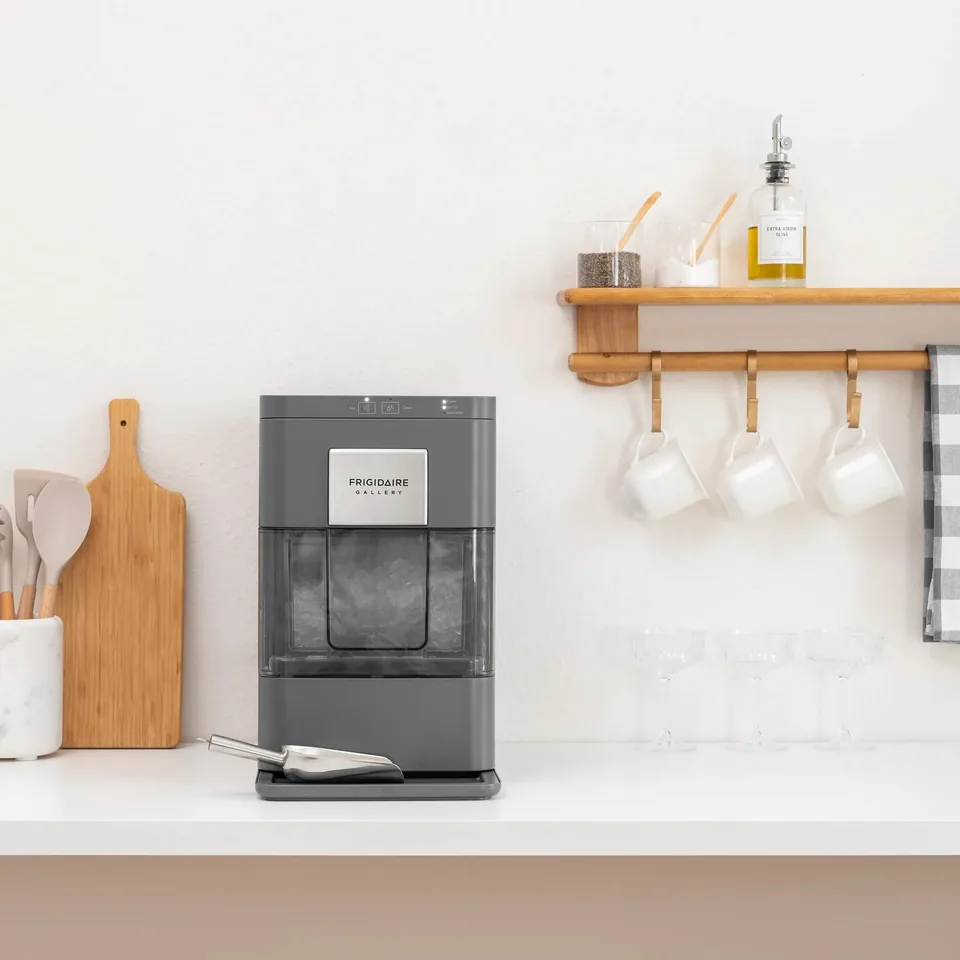
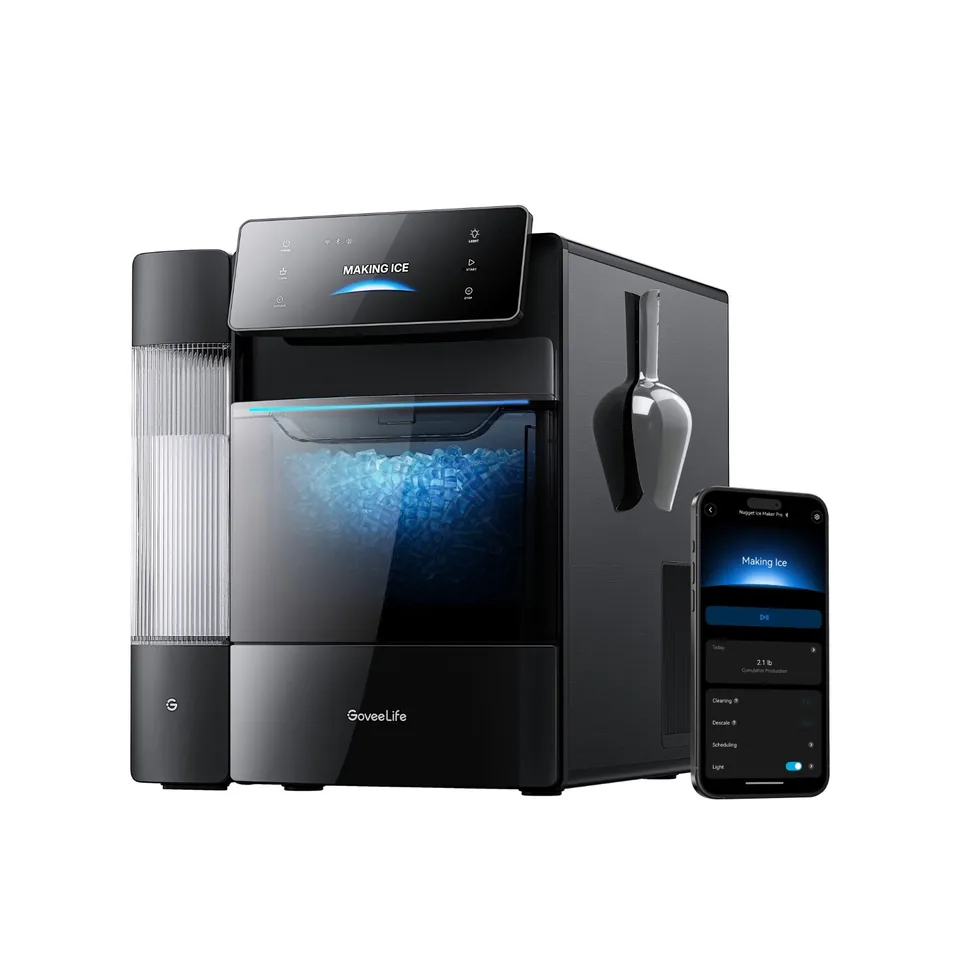
Nugget ice, also sold as pellet or chewable ice, is made differently from the cubes in a freezer tray. A countertop nugget machine freezes a thin layer of ice on the inside of a chilled cylinder, an auger scrapes it off as flakes, and the flakes are pressed through a die into small, airy pellets. That is why the ice chews easily, and why these machines need more care than a cube maker: the auger and die are where minerals build up.
01Daily output versus bin size
The headline number on every box is pounds per day, but what you live with is the bin. A countertop nugget maker does not freeze its ice. The bin is insulated but not refrigerated, so the ice slowly melts; on the GE Opal machines, Reviewed notes, the meltwater drains back to the reservoir to be made into ice again. Either way, the bin is a buffer, not storage.
Rated output assumes cool water and a cool room. GE rates the Opal Mini at 60°F water in a 70°F kitchen, and Frigidaire's manual says to run the EFIC255 below 90°F. For daily drinks for two to four people, any of these keeps up. For a party, the bin matters more: Reviewed timed the GoveeLife at just over 90 minutes to fill its 3.5-pound bin, while a 2-pound bin like the Opal Mini's empties after a few pitchers and then refills at about a pound and a half an hour.
02Noise
These machines run a compressor, a fan and an auger, and the auger's crunch is the sound owners notice. Manufacturer figures are a starting point: GoveeLife rates the Pro at 40 dB, GE lists 44 dBA for the Opal 2.0 Ultra and 45 dBA for the Opal Mini. Reviewed describes the Frigidaire as comparable in volume but with irregular growling noises rather than a steady hum, which some people find harder to ignore. Popular Mechanics compared the Opal 2.0 Ultra, while making ice, to a loud refrigerator, and found it nearly silent once the bin was full. GoveeLife says its AI NoiseGuard feature spots an impending freeze-up and runs a defrost cycle before the auger starts to screech; Reviewed heard no such noise during its test period. If the machine will sit in an open-plan living space, put the quieter rating and a schedule (the Opal 2.0 Ultra and the GoveeLife can both make ice on a timer from their apps) above raw output.
03Cleaning and descaling
This is the part buyers underestimate. Every nugget maker needs two kinds of maintenance. Sanitizing kills the film that grows in standing water; GE recommends it weekly for the Opal, and Frigidaire's manual adds that the reservoir water should be changed every 24 hours. Descaling dissolves the mineral scale that eventually slows or jams the auger, and how often you need it depends on your water. GE's own chart runs from every two to four months with soft water down to every two to three weeks with very hard water, and a vinegar descale of an Opal involves an 18-hour soak followed by rinse cycles, so plan for a night without ice.
The machines differ in how much they help. The Opal 2.0 Ultra ships with a scale-inhibiting filter (rated for three months) and separate sanitize and descale alerts. The GoveeLife has a 10-minute quick-clean mode, a 30-minute descale mode and app reminders. The Opal Mini has a 3-minute clean cycle, a flip-open front panel and drain points meant to leave no trapped water. The Frigidaire has a Clean button that runs about 20 minutes and a drain plug at the back. Distilled or softened water cuts descaling on all of them; GE lists distilled water as optional but helpful.
04Reservoir, side tank or water line
None of these four connects to a water line. Countertop nugget makers are fill-by-hand appliances, and the difference is how often you refill. A side tank, which the Opal 2.0 Ultra and the GoveeLife include, feeds the internal reservoir automatically: Reviewed found the GoveeLife's 7.1 liters lasted its household about a week, and Reviewed notes that the Opal's side tank lets it make three times as much ice as the reservoir alone. The Frigidaire and the Opal Mini rely on their internal reservoirs, which means topping up every day or two with regular use; the Mini's top-fill lid at least spares you pulling out the bin. If you want ice with no refilling at all, you are shopping for a plumbed undercounter ice machine, which needs a water supply, usually a drain and installation. That is a different category from this list.
Measure the space under your upper cabinets and remember ventilation. The Opal Mini is 8.6 inches wide, 15.6 deep and 14.56 tall, and GE asks for 4 inches of air on the sides and back. The Opal 2.0 Ultra with its side tank measures 13.43 inches wide, 17.5 deep and 16.5 tall. The Frigidaire is 10.6 wide, 14.6 deep and 16.5 tall in its manual, and wants more than 15 centimeters of clearance at its hot-air outlet. The GoveeLife is the largest at about 14 inches wide and 17 tall, and at roughly 42 pounds it is not something you move to the bar cart for a party.
06Nugget or bullet ice
If chewable texture is not the point, a bullet-ice maker is the cheaper and lighter alternative. Machines like the Igloo IGLICEB26HNAQ and Frigidaire EFIC189 freeze hollow, bullet-shaped pieces on chilled prongs and are generally smaller than a nugget machine. Reviewed picked the Igloo, with its carry handle and 26-pound daily rating, for portability, and faulted the EFIC189's small basket. Bullet ice is hollow, so it melts faster than solid cubes, and it does not have the soft chew people buy a nugget maker for.